

Why does every place tax so differently?All 50 states, 50 big cities and Northern Virginia, in plain English: 2026
Texas has no income tax and big property bills. New Jersey has 564 towns. California and Florida cap what long-time owners pay. Virginia taxes your car every year. None of it is random.
Two tax bills, same house, two states· Reston, Fairfax County
Numbers: Census, Tax Foundation, Lincoln Institute, NAEP and the county budgets, checked November 5, 2026.
Start here
Pick any state and see how it pays its bills.
Virginia
In plain words. The colored bar shows where each tax dollar in that state comes from. Under it, every number has a rank: #1 is the highest of the 50 states. For a tax, #1 means the most expensive, not the best.
The bar is every tax dollar the state and its local governments collected in fiscal year 2023, by kind of tax.1 Ranks count the highest as #1. Income tax: the state’s own top rate; places where cities or counties add their own are marked.33,34 Local governments: Census, 2022.2 School money and spending per student: Census, 2023 to 2024.3 Test scores: NAEP 2024.4 Largest city: the Lincoln Institute’s study of taxes paid in 2025, new buyer of the median-valued home.5
All 50 states, each with its tax mix, rates, schools and ranks, and how it compares with Virginia.
Updated November 6, 2026Sources checked November 4 and 5, 2026A 2-minute state picker, plus a 10-minute read
Quick answer
There is no national property tax, so each state makes three big choices. It picks its mix of income, sales and property tax1; it decides how much of the school bill the state pays3; and it decides how many local governments can tax a home2. Texas and Florida have no income tax, so homes and shopping carry more. New Jersey and Illinois split property tax among thousands of local governments. California, Florida and New York City cap what long-time owners pay5. In Northern Virginia, schools take the biggest share of every county budget, and Loudoun is the #1 U.S. county by median household income8.

Taxes across America, in four numbers
Published data, each with its source
Rates and bills are published averages and examples, not a quote for any one home.
Compare
Put any two states side by side.
Pick two states, or tap a popular matchup. The same house, the tax mix and ten numbers, with the bigger one marked.
Tap any state to compare it
Where in Virginia
Where each tax dollar comes from
Side by side
In plain words. Each row puts the two states side by side. The longer bar is the bigger number. A red tag means that state takes more in tax by that measure; a gold tag just marks the higher number, which can be good news (more school money, better scores, fuller pensions).
Same house: each state’s average home property tax rate in 2024 (median tax paid as a share of median home value), so a county inside the state can be higher or lower; Fairfax, Loudoun and Arlington run above Virginia’s 0.78%.1 Tax mix, tax burden, property tax per person, debt and pensions: Tax Foundation, Facts and Figures 2026.1 Income tax: each state’s own top rate; local income taxes on top are named under the two big boxes.33,34 School money and spending: Census, 2023 to 2024.3 Test scores: NAEP 2024.4
For life
Are you winning, or just paying a different way?
Pick where in Northern Virginia you would buy and a city to compare, add your home price and income, then slide how fast the house grows and how long you keep it. Every year’s taxes, added up for life.
More settings20% down, 7% rate, income +3% a year, 2 cars
Taxes you pay each year
Tax rules change, so the winner can change
The simulator uses today’s rates in every year. Real rates move, on a steady clock:
How to read the total: it is what you would pay if today’s rules held. The longer you keep the home, the more the rules will have moved, so treat a 20-year total as a direction, not a promise, and run it again each year with the new rates.
In plain words. Each place starts at its own typical price, because a house in Houston costs far less than one in Fairfax. Every year the house changes in value, each place at its own speed, and its property tax follows. Northern Virginia also takes income tax every year; the other place does not (except Los Angeles and Sterling Heights). The green card shows who pays less tax; the blue card shows whose house gains more by the time you sell; the line under them puts both together and takes off the mortgage interest, because a pricier house means a bigger loan. A house that grows faster costs more in tax but pays you back at the sale.
An estimate, not a tax bill. Each place starts at its own median sale price for the kind of home you pick, which you can slide.42,43 Each place’s home value grows at its own rate, set from its own past sales (the federal house price index), which you can change.41 Today’s tax rates and income tax brackets in every year; in real life rates move, and Virginia counties often trim the rate when values jump. Year-one property tax for a new buyer, from my $1.2 million house table.20 Caps: a Texas homestead’s taxable value can rise at most 10% a year;26 Florida 3% a year (or inflation, if lower), with the $50,000 homestead exemption and, from your fifth year, Amendment 3’s $250,000 exemption from non-school taxes;7,24,25 California 2% a year under Prop 13.17 Michigan: half the market value is taxed; the year after you buy it resets to half the price, then it can rise only with inflation (2.7% for 2026) or 5%, whichever is less; we use 2.7% every year and the full price from year one.28 Virginia has no cap. Income tax: a married couple filing jointly. Virginia: 2% to 5.75%, a $930 exemption each, and the standard deduction ($17,500 in 2026, $18,400 in 2027, $18,600 from 2028) unless you itemize.22,31 You itemize when the mortgage interest (on up to $750,000 of loan) plus state and local taxes, within the federal SALT limit, beat the federal standard deduction of $32,200; Virginia then lets you deduct the interest, the house tax and the car tax, and limits the total above $399,200 of income.30,31 The loan is a 30-year fixed at the rate in the box.44 California: its own brackets, with mortgage interest on up to $1 million of loan, the house tax and the vehicle fee when that beats its standard deduction.23 Michigan: 4.25%, $5,900 exemption each, no city income tax in Sterling Heights.28 Social Security is not taxed in Virginia, so leave it out of the income box. Sales tax: each city’s own 2026 rate (Northern Virginia 6%, Houston 8.25%, Seattle 10.55%, Los Angeles 10.25%),29 on taxed spending of 25% of the first $100,000 of income and 10% of the rest. Car tax: each county’s 2026 rate and relief, the same every year;14 Seattle’s Sound Transit car tabs, 1.1%;27 California’s 0.65% vehicle license fee.17 Not counted: federal income tax (both places can deduct their state and local taxes, up to the SALT limit), groceries (Virginia taxes them at 1%, Nashville at 6.25%, the others not at all), local restaurant meals taxes, Virginia’s age deduction, Texas’s exemptions and school tax freeze at 65, local senior relief, insurance and HOA fees.
The debate
No income tax, bigger house tax: good deal or not?
The honest case on both sides, and who comes out ahead.
A state has to raise its money somewhere. Take away the income tax and the bill moves to your house, your shopping or both. So the real question is not “which state has no income tax?” but “who ends up paying, and when?” Here is the honest case on each side.
ForNo income tax, bigger house tax
- Your raises stay yours. Texas, Florida, Tennessee and Washington do not tax wages. In Virginia a married couple earning $400,000 pays about $21,629 a year in state income tax, and every dollar of income over $36,360 pays 5.75%.22
- Caps protect owners who stay. A Texas homestead’s taxable value can rise at most 10% a year, Florida’s 3%, California’s 2%. Virginia has no cap: every home is reassessed at market value each year.7,17,26
- Retirees can lock in. In Texas, school taxes on the home of an owner 65 or older stop rising, and that ceiling can move with them to a new home.26
- You choose part of the bill. Sales tax is paid when you buy. Spend less, pay less. Visitors and tourists pay it too.
- Lower overall. Counting every state and local tax, Texas takes 8.6% of residents’ income and Florida 9.1%; Virginia takes 12.5%.1
AgainstThe catch
- The house bill comes even in a bad year. Lose a job, retire, take a pay cut: income tax shrinks with you. Property tax does not.
- You pay tax on paper gains. When the house goes up in value, the bill follows, though you have not sold it or earned a dollar. (This is true in Virginia too, and without a cap. What changes is the rate the growth is taxed at.)
- The bigger the house, the bigger the gap. On a $1.5 million house, Dallas charges about $9,806 a year more than Fairfax County. That equals Virginia’s income tax on a household income of about $194,000. Earn less than that, and in year one the house tax costs you more than the income tax you save.20,22
- Newcomers pay for the caps. In Miami a new buyer pays a tax rate 3.2 times that of a neighbor who bought in 2012.5 And Florida’s new, bigger homestead exemption reaches people who move there after 2026 only in their fifth year.24
- Renters pay it too. A landlord’s property tax is built into the rent, and sales tax takes a bigger bite from smaller paychecks, since they spend more of what they earn.
Who wins, who loses
There is no free state. No income tax is a clear win for high earners and for owners who stay put under a cap. For a big house on a middle income, Northern Virginia can cost less: a $1.5 million house and a $150,000 income come out about $69,000 ahead in Fairfax County over 20 years, compared with Dallas (4% growth a year, two cars). Run your own numbers in the simulator above.
After November 3, 2026
Five states switched governors. Will their taxes change?
Who won in all 36 governor races, what they said they would do about taxes, and who else has to say yes.
On Tuesday night, November 3, 36 states picked a governor. When the counting slowed on Wednesday, five governor’s offices had switched from Republican to Democrat: Texas, Ohio, Georgia, Iowa and Nevada. None switched the other way. Two more, Alaska and Kansas, are still too close or not yet called.45
If you are moving here from one of those states, or weighing a move there, the honest answer is that a new governor can push taxes in a new direction, but cannot change them alone. Here is who won, what they said they would do about taxes, and who else has to say yes. Virginia did not elect a governor this year; what changed here is further down.
Tap a state: who won, and what it could mean for taxes
In plain words. Dark blue states traded a Republican governor for a Democrat on November 3. Light blue and light red kept the same party, so the governor’s office did not change direction there. Gray states did not vote for governor this year. Tap any state to read it right here.
Unofficial results, checked November 5, 2026. Kansas and Alaska update when the Associated Press calls them.45,52
All 36 races, by result
In plain words. Dark blue names switched party; dashed gold ones are not called yet. Tap any name to read it in the box just above.
Why a new party in the governor’s office can change your taxes
A governor does three things that steer taxes. They write the first draft of the budget, which says how much the state plans to collect and spend. They can veto a tax bill they do not like. And they set the agenda: the ideas they campaign on become bills. When the governor’s party also holds both chambers of the legislature, it can usually pass its plan. When power is split, nothing big moves without a deal.
What the candidates in the switched states actually proposed
Their own plans, as reported before the vote. Not an endorsement of either side.
Democratic candidatesTargeted relief
- Ohio, Acton (won): property tax rebates up to $1,000 when a bill jumps more than 4%, new credits for working families, end breaks for incomes over $1 million.48
- Georgia, Bottoms (won): no state income tax for teachers; bigger homeowner relief grants; against ending property tax.49
- Texas, Hinojosa (won): cut homeowners’ property taxes, partly by cutting corporate subsidies; $1,500 per household.47
- Nevada, Ford (won): no tax increases; against resetting property values.51
Republican candidatesBroad cuts
- Ohio, Ramaswamy: phase out the state income tax over about ten years; roll property taxes back to 2021 and cap growth.48
- Georgia, Jackson: halve the income tax in four years, end it in eight; freeze property taxes.49
- Texas, Abbott: let voters end school property taxes for homeowners; tighter limits on appraisal increases.47
- Nevada, Lombardo: no new taxes; against resetting property values.51
In plain words. This year’s Republican plans mostly cut or ended a tax for everyone, the income tax above all, and capped what homes can be charged. This year’s Democratic plans mostly aimed relief at certain groups (teachers, seniors, working families, owners hit by a jump) and paid more of the school bill from the state, which takes pressure off local property tax. Both sides promised property tax relief. And Nevada shows the pattern is not a rule: both candidates there pledged no new taxes.
A governor cannot change taxes alone
- 1Governor proposesthe budget and tax ideas
- 2House passes ita majority, or more
- 3Senate passes itthe same bill, word for word
- 4Governor signsor vetoes; lawmakers can override
- 5The constitutionsome changes need two-thirds, or the voters
Who holds each step now, in the five switched states:
Texas
- GovernorHinojosa (D)
- HouseDemocrats won it
- SenateRepublicans kept it
Ohio
- GovernorActon (D)
- HouseRepublican
- SenateRepublican
Republicans lost their two-thirds House majority.46
Georgia
- GovernorBottoms (D)
- HouseStill counting
- SenateStill counting
Income tax already set by law to fall to 3.99%.49
Iowa
- GovernorSand (D)
- HouseRepublican
- SenateRepublican
New: two-thirds of both chambers to raise income tax rates.50,53
Nevada
- GovernorFord (D)
- HouseDemocratic, two-thirds
- SenateDemocratic, one seat short of two-thirds
Two-thirds of each chamber to raise any tax.51
In plain words. Only Nevada handed one party every step, and even there a tax increase needs two-thirds, which Democrats are one Senate seat short of. In Ohio and Iowa a Democratic governor faces a Republican legislature, so expect vetoes and deals more than sweeping change. In Texas the new governor’s party won the House but not the Senate, and no governor can bring in an income tax there.
Legislature results are unofficial; some chambers are still being counted.46
In 16 states, voters decided taxes directly
Bigger homestead exemption from non-school property taxes: $150,000 in 2027, $250,000 in 20286
62% yes (60% needed: the black line)Income tax rate capped at 3.5% in the constitution54
62% yes (50% needed: the black line)Lawmakers must limit how fast local property tax collections grow53
Two-thirds of both chambers needed to raise income tax rates53
Local grocery taxes capped at 2%, voters must approve increases (Prop 316)54
61% yes (50% needed: the black line)Extra homestead exemption for owners 65 and older, if the parish opts in54
Repeal the new 9.9% tax on income over $1 million (I-645)54
42% yes (50% needed: the black line)One-time 5% tax on billionaires’ wealth (Prop 40)54
45% yes (50% needed: the black line)Tighter limits on home assessments53
Large exemption on home values53
Graduated income tax, 3.7% to 8.4%, in place of the 4.4% flat rate (Amendment 87)54
50.5% yes (50% needed: the black line)In plain words. These skip the governor entirely: the voters wrote the rule. The bar is the share who voted yes; the black line is what it needed (50%, or 60% in Florida). Most of the property tax questions that passed protect owners who already live there; Florida’s bigger exemption reaches newcomers only in their fifth year.24
About 30 tax questions were on ballots in 16 states.54 Shares are early counts where shown.
And here in Northern Virginia?
Richmond: no change this year
Virginia elects its governor the year after a presidential election, so there was no race on November 3. Abigail Spanberger (D) took office in January 2026 with Democrats in charge of both chambers. The General Assembly writes the next round of state tax law starting January 13, 2027, and all 40 State Senate seats are on the ballot November 2, 2027.55
Your county: bonds and one sales tax
Voters approved every bond question: two in Fairfax County (about 70% yes), three in Loudoun (66% to 76%) and five in Arlington (76% to 88%). Bonds are borrowing, paid back over years from the county budget, where the real estate tax is the biggest source. The City of Fairfax approved up to a 1% sales tax for schools and transit (56% yes); it starts only if City Council adopts it. Statewide, 14 of 47 places approved the school sales tax.9,56
Washington: the SALT cap
Democrats won both the House and the Senate, seated in January; any tax law still needs the President’s signature or two-thirds of each chamber.54 Worth watching here: the federal deduction for state and local taxes is capped at $40,400 for 2026 and drops to $10,000 in 2030 unless Congress acts.57 A $900,000 Fairfax County home pays about $10,382 a year in real estate tax alone, before any Virginia income tax.20
Elections change who proposes taxes, not the tax bill you pay next month. Real changes arrive months later, through a budget the legislature passes, and the biggest swings happen where one party now holds every step. If you are deciding between two states, the rates on this page are today’s; check back after the 2027 legislative sessions, when these plans either become law or do not.
The tax seesaw
Taxes are not set in stone. States keep moving them.
Push one tax down and another usually goes up. For 50 years Texas, New York, Virginia and every other state have kept moving the seesaw. Here is the story, with the real numbers.
The seesaw: income tax on one side, the house on the other
Every state has to collect its money somewhere. Put less on one side and more lands on the other. Tap a state to see how it balances, in cents of every state and local tax dollar (fiscal 2023).1
The rest of each tax dollar comes from sales tax, business taxes and other taxes, shown in the state picker at the top of this page.
In plain words. The heavier side sinks. Texas puts almost nothing on income and a lot on the house; Oregon does the opposite; Virginia sits close to level. No state gets to leave both sides empty.
Time machine: what each state charged, 1976 to 2026
The state’s own top income tax rate on wages, every year. City income taxes are not in the lines; each state’s big-city figure is in the list.
In plain words. Each line is one state's rate, year by year. A flat line means the state held still; every step is a law or a vote that moved it. Slide the year, or press Play, and watch the rates change. The last column is what people pay today in a big city, with the local add-ons the lines leave out.
Lines: the state’s own rate, in effect on December 31 of each year; top rate means the income tax rate on the highest bracket of wages.35 Last column: what you pay today in that state’s big city (Northern Virginia for Virginia), with county, city and transit add-ons, and New York City’s own income tax on top of the state’s.29,34
50 years of moves, one at a time
Every card is a real change. ▲ raised, ▼ cut, ⇅ one tax swapped for another, ■ a new limit, = held steady.
- 1976 to 1997▼Cut
New York cuts its top rate by more than half
In 1976 New York’s top income tax rate was 15%. Twenty years of cuts brought it down to 6.85% by 1997.35
- 1978■New limit
California caps the house tax
Proposition 13 held property tax to 1% of value, rising at most 2% a year. Income tax took more of the load: California’s top rate is 13.3%, the highest of the 50 states.1,17
See the two-neighbors calculator › - 1987 to 1990▲Raised
Texas turns to the cash register
With no income tax, Texas raised its state sales tax from 4.125% to 6% in 1987, then to 6.25% by 1990. That rate still stands today.35
- 1991⇅Swapped
Connecticut swaps one tax for another
Connecticut started an income tax (4.5% top rate by 1992, 6.99% today) and in the same year cut its sales tax from 8% to 6%. A seesaw in one move.35
- 1997▼Cut
Texas triples the school homestead exemption
Voters raised the part of a home’s value that school taxes skip from $5,000 to $15,000. It would keep climbing (see the chart below).36
- 2004 and 2013▲Raised
Virginia raises its state sales tax
3.5% to 4% in 2004, then 4.3% in 2013. Counties and cities add their own share on top.35
- 2006⇅Swapped
Texas cuts school tax rates by a third
The top school tax rate fell from $1.50 to $1.00 per $100 of value by 2007. To help pay for it, a new tax on business “margins” started in 2008. Property down, business tax up.37
- 2006■New limit
Virginia freezes its car tax relief
Since 2006 the state has paid counties a fixed $950 million a year toward the car tax. As car values rise, the same check covers a smaller share of your bill.14
See what one car pays › - 2009 to 2019⇅Swapped
New York raises income tax, then caps the house tax
The top rate went back up to 8.97% in 2009 and 8.82% from 2012. In 2011 a new law held most local property tax levies to 2% growth a year or inflation, whichever is less; it became permanent in 2019. Today’s top rate: 10.9%.35,39
- 2011 to 2018⇅Swapped
Illinois goes up, down and up again
One flat rate for everyone: 3%, then 5% in 2011, back to 3.75% in 2015, then 4.95% from 2018.35
- 2014 to 2026▼Cut
North Carolina cuts, year after year
Its top rate fell from 7.75% to 5.8% in 2014 and keeps stepping down: 3.99% in 2026, with 3.49% planned for 2027.35
- 2019■New limit
Texas writes “no income tax” into its constitution
74.35% of voters said yes. Changing it now would take another statewide vote.18
- 2023▼Cut
Virginia drops the state’s grocery tax
From January 1, 2023, groceries pay 1% instead of 2.5%. The state’s 1.5% is gone; the 1% local tax remains.40
Texas: the part of a home’s value school taxes skip
The homestead exemption for school district taxes, for a home you live in. Bigger exemption, smaller school tax bill.
On a $400,000 Texas home you live in, school taxes were figured on $385,000 of value after 1997. Since 2025, on $260,000.
In plain words. Each bar is how much of a home's value Texas school taxes skip. The longer the bar, the smaller the school tax bill on the same house.
Not counted: extra exemptions for owners 65 and older or disabled, and county and city exemptions, which are separate.18,36
Why states keep moving the seesaw
When revenue falls short, rates tend to go up. In good years, there is room to cut.
New Jersey’s first income tax followed a 1973 court ruling on how schools were paid for.
California, Texas and Florida all changed their tax rules at the ballot box: 1978, 2019, 2023 and 2026.
When one state cuts, its neighbors feel the pull. North Carolina has cut its top rate every few years since 2014.
Don’t pick a state on today’s rates alone. Over the 10 to 30 years you own a home, at least one of them will move. Ask which taxes a state leans on, how often it changes them, and which way it has been going.
Taxes are the price tag. The life is what you are buying.
It is not black or white. No income tax, or low taxes, is one good line on a long list. The right state is the one where the whole package fits you, and Texas, Virginia, California and Florida each fit different people.
Build your package. Tap everything that matters to you.
Low taxes can’t hire you, can’t babysit and can’t bring you fall colors. Weigh the whole package.
Weighing Northern Virginia against another state? Book a call ›Read this first
Tax numbers, in plain English.
A rate converter, why the same place shows three different rates, and the twelve words this page uses.
Turn a tax rate into a yearly bill
2026 real estate rates per $100 of assessed value. Fairfax includes its small stormwater and pest charges; Prince William is the base rate before its fire and other district levies; Leesburg is the county plus the town.10,11,12,13,20,21 Your bill also depends on any relief you qualify for.
Three “rates” for one place, all correct
Fairfax County’s 2026 rate is $1.1535 per $100, the rate the county sets.20 The Census survey puts Fairfax homeowners at 1.00%: what owners said they paid, divided by what they said the home is worth, over 2020 to 2024.8 The Tax Foundation puts all of Virginia at 0.78%, because the state figure includes many rural counties with much lower rates.1
So compare a rate only with the same kind of rate. This page says which kind every time.
Each source has its own calendar
Every number here is the newest its source has published, as of November 5, 2026: tax burden for 2022, the tax mix for fiscal 2023, home rates for 2024, big-city bills for 2025, and Northern Virginia rates and budgets for 2026 and fiscal 2027. Big national studies take two to three years to collect and check.
Inside one chart, every number is from the same year, so the comparison is fair. Between charts, look at the pattern, not the exact figure.
Words on this page
- Per $100
- The way Virginia writes a property tax rate: dollars for every $100 of assessed value. $0.805 per $100 is the same as 0.805%. On a $1,000,000 home that is $8,050 a year. Try it above.
- Assessed value
- The value the county puts on your home for tax. Northern Virginia reassesses every home every year at market value, as of January 1. California, Florida and New York City cap how fast it can rise, so there it can sit far below what the home would sell for.
- Home property tax rate
- What owners actually paid, divided by what their homes are worth (an “effective” rate). It counts exemptions, caps and relief, so it is often lower than the rate a county sets. Virginia statewide: 0.78% in 2024.
- Homestead exemption
- A slice of a home’s value that is not taxed because the owner lives there. Florida exempts up to $50,000 now, more from 2027; Texas exempts $140,000 from school taxes. Virginia has none for most owners; it offers relief to some older and disabled owners and some disabled veterans.
- Tax burden
- All the state and local taxes a state’s residents pay, including taxes they pay to other states, as a share of their income. It is the fairest single way to compare whole states.
- Median
- The middle one: half are above, half below. It is better than an average for homes and incomes, because one mansion can’t drag it up.
- Fiscal year
- A government’s budget year. Northern Virginia’s counties and cities run July 1 to June 30, so fiscal 2027 is July 1, 2026 to June 30, 2027.
- General fund
- A county’s main account. Real estate tax, car tax and most other local taxes go in; schools, police, fire and most services are paid from it.
- Personal property tax
- A yearly tax on things you own that are not land or buildings. In Virginia that mostly means cars, at a rate per $100 of the car’s January 1 value.
- Local government
- Any government smaller than the state that has its own budget and can tax you or charge you: a county, a city or town, a township, a school district, or a “special district” that does one job, such as fire, a library, a park, flood control, a hospital or water. Each one can put its own line on your property tax bill. In Northern Virginia a home usually answers to just one, the county or city (plus a town in places like Leesburg), because the county also runs the schools. In Illinois the same home can sit inside eight or more at once.
- NAEP score
- The Nation’s Report Card: the same test, given to a sample of students in every state, scored from 0 to 500. In 2024 8th-grade math, states ran from 256 to 283, so a few points is a real difference.
- Rank #1
- Always the highest of the group. For a tax, #1 is the most expensive. For income or test scores, #1 is the top.
The puzzle
The same $1.2 million house gets a very different bill.
Yearly property tax on a $1.2 million house, year one
In plain words. Same price, same year, same kind of house. The only thing that changes is where it sits, and the bill swings by thousands of dollars a year.
Northern Virginia, Houston and Dallas use 2026 rates (typical Texas homestead exemptions assumed); New Jersey uses each town’s 2025 rate. A Los Angeles buyer pays this much; a neighbor who bought decades ago pays far less (see California below).20
There is no national property tax. The U.S. Constitution leaves most taxes to each state, and each state writes its own rules for its counties, cities and school districts. So your bill comes out of a few big choices your state made, some of them more than 100 years ago.
A state with no income tax, like Texas or Florida, has to lean harder on homes and shopping.
Schools are the biggest local cost. Where the state pays less of it, your property tax pays more.
One county bill in Fairfax. Eight taxing units on one Houston bill. Each layer adds a rate.
Big cities
Chicago, New York, Miami and 47 more big cities.
What the median home pays in the 50 largest U.S. cities, for a new buyer and for a long-time owner.
The 50 largest U.S. cities: property tax on the median-valued home, taxes paid in 2025
In plain words. New buyer is what you would pay if you bought that city’s typical home in 2025. Long-time owner is what a neighbor with the same home pays after owning it for the city’s average length of time. Where the city caps yearly increases, the neighbor pays less. Where there is no cap, the two match.
Red: Chicago, New York City and Miami. Navy: Washington, D.C. and Virginia Beach, the closest to Northern Virginia. #1 is the highest of the 50.5
on the median $341,200 home, a 1.55% rate, for a new buyer and a long-time owner alike, because Illinois has no cap on yearly assessment increases.5 Illinois has 6,930 local governments, the most of any state,2 and its public pensions are the least funded in the country, 54% in 2025, so part of every bill pays for old promises.1
a year on the median $778,600 home: the first is a new buyer, the second an owner of average length, because the city limits how fast a home’s assessed value can grow.5 New Yorkers pay the highest share of income in state and local taxes, 15.9% (2022), and New York City adds its own income tax on top of the state’s.1
a year on the median $598,200 home. A new buyer’s tax rate is 3.2 times that of a neighbor with the same-value home bought in 2012, the biggest gap among the 50 cities.5 Florida has no income tax, caps a homestead’s assessment increase at 3% a year or inflation, whichever is less,7 and on November 3, 2026 voters approved Amendment 3, raising the homestead exemption from non-school taxes to $150,000 in 2027 and $250,000 in 2028.6
All 50 states
Every state slices the pie its own way.
Think of state and local taxes as one pie. Every state has to pay for the same kinds of things: schools, police, fire, courts, parks, roads. But each one picks its own mix of three main taxes: income, sales and property.
Pull one slice out and the others have to grow. Nine states have no tax on wages, and in most of them property or sales tax picks up the slack. New Hampshire gets 59.5% of its taxes from property, the most of any state. Oregon gets 42.3% from income tax and only 4.1% from sales tax, because it has no general sales tax.1
In plain words. Darker means higher. Tap a state to see its number and its rank. The home rate here is what owners actually paid divided by what their homes are worth, so it already counts exemptions and caps. That is why it can sit below the rate a county sets.
Home property tax rate: property tax paid as a share of home value, owner-occupied homes, 2024. Shares: fiscal year 2023. Tax burden: 2022.1 Spending per student: 2023 to 2024.3 Math: NAEP 2024.4
Home property tax rate, 2024: the 10 highest
In plain words. The same numbers as the map, lined up, so you can see exactly where each state falls.
The list follows the map’s choice above. Virginia in red; #1 is the highest of the 50 states.1
Schools
Who pays for the schools decides a lot.
Public schools are the single biggest thing local taxes pay for. Every state splits the bill between local taxes (mostly property tax), the state budget, and a smaller slice from Washington. That split is a big reason property tax runs high in one state and low in another.
In California, the state pays more than half, 53.4%, largely from income tax. In Texas, Illinois, New York and Florida, local sources pay more than half.3
Where school money came from, school year 2023 to 2024
In plain words. Each bar is one school dollar, split by who paid it. The bigger the local part, the more of the school bill lands on homeowners through property tax.
Census Bureau, Annual Survey of School System Finances, fiscal year 2024, Table 5. Percent of all public school revenue.3

Northern Virginia pays more of its own way. Virginia’s school formula sends less state aid to places that can pay more, using a measure of each locality’s wealth. So Arlington, Loudoun and Fairfax cover two thirds or more of school costs with local money, far above the state’s 48.9%.
Northern Virginia school systems, same school year
In plain words. Northern Virginia pays most of its own school costs. The state formula sends more aid to places with less wealth, so richer counties get less.
My math from the Census school-system file for fiscal year 2024. Prince William County’s 49.9% local share is close to the state average, so it gets the largest share of state aid of the five.3
Layers
How many governments sit on top of your house.
A local government is any government smaller than the state that has its own budget and can tax you or charge you. Each one can add its own line to a property tax bill. The more of them stacked over one house, the more rates add up, and the harder the bill is to follow. The U.S. has 90,837 of them.2
The five kinds, and how many the U.S. has
Census Bureau, 2022 Census of Governments.2
One house, how many layers of government tax it?
Each slab is a separate government with its own budget and its own tax rate, stacked over the same house. Color shows the kind.
A house in Fairfax County, Virginia
The county runs the schools too, so it is one bill and one rate. Inside a town such as Vienna or Herndon, the town adds a thin second layer (dashed).
A house inside Houston city limits, Texas
Eight separate rates add up to more than $2.13 per $100 of value before exemptions.
A house in an Illinois suburb
A typical mix. The exact layers change from street to street, and many bills carry more, such as a forest preserve or mosquito district.
Virginia: county and city rules.16,20 Houston: my $1.2 million house table, with its own sources.20 Illinois: the kinds of local governments the Census counts there, 1,425 townships, 890 school districts and 3,218 special districts.2
Every state, counted, and why
In plain words. The big bold number is how many local governments the state has. The colored bar shows what kind they are. Virginia is always on the list so you can compare.
Census Bureau, 2022 Census of Governments: county governments, cities and towns, townships, independent school districts and special districts.2 Independent cities: Library of Congress.16 New Jersey’s 1894 laws: Karcher.19
Why so many small towns?
New Jersey has 564 towns and 521 school districts packed into a state smaller than Massachusetts.2 Much of it dates to the 1890s. A pair of 1894 state laws made it easy for a neighborhood to break away from its township and run its own schools. About 40 new boroughs formed in 1894 and 1895 alone, 26 of them in Bergen County. Historians call it “boroughitis.”19
The towns never merged back. Each one has its own police, public works, schools and staff, and each funds them mostly with property tax. That is a big part of why New Jersey’s property tax per person, $3,590 in fiscal 2023, is the highest of any state.1
One Houston bill, eight taxing units
Inside Houston city limits, one home pays Harris County, its flood control district, the port, the hospital district, the county education department, the community college, the city and Houston ISD: more than $2.13 per $100 of value before exemptions.20 Texas has 2,984 special districts.2
In Fairfax County, the county sets one rate for county services and schools together: $1.1535 per $100 of assessed value in 2026, including small stormwater and pest charges.20
Virginia’s rules
Virginia plays by two unusual rules.
Dillon’s Rule: Richmond holds the keys
In 1868, Iowa judge John F. Dillon wrote that a local government has only the powers its state gives it, plus what those powers clearly imply. If there is doubt, the answer is no. Virginia’s courts still follow that rule.16
So a Virginia county cannot invent a new tax. The General Assembly decides which taxes a county or city may use, and many have a ceiling in state law. That is why Northern Virginia leans on real estate tax, the car tax and a handful of state-approved local taxes, and has no local income tax the way many Maryland counties do.
New Jersey works the other way. It is a home rule state: its towns have broad powers to run their own affairs, which is part of why so many small ones survive.
Independent cities stand alone
In most states a city sits inside a county and pays both. In Virginia, a city is fully separate from the county around it. The U.S. has 41 independent cities and 38 of them are in Virginia; the other three are Baltimore, St. Louis and Carson City.16
That is why Alexandria, Falls Church, the City of Fairfax, Manassas and Manassas Park each set their own rate, while towns like Vienna, Herndon and Leesburg add a town rate on top of the county’s.
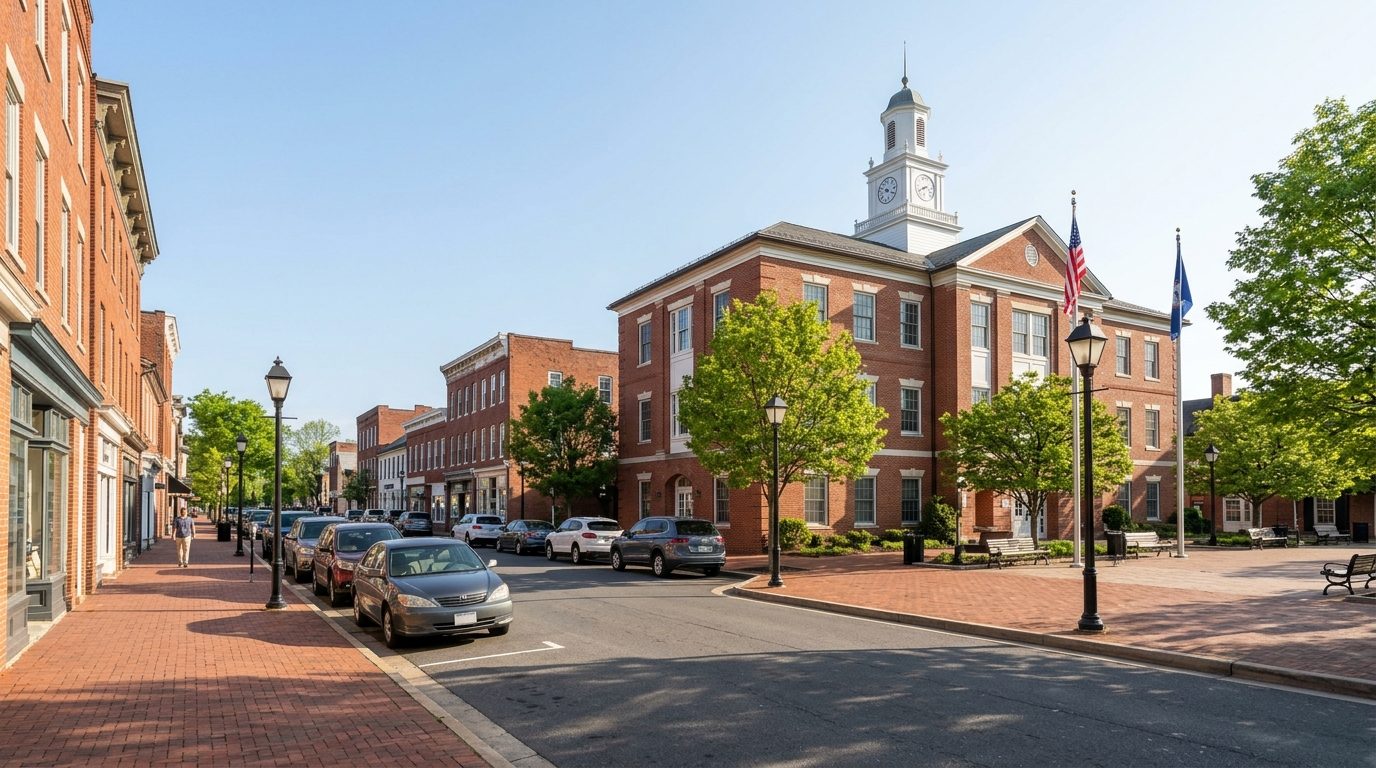
Homes inside the town limits pay Loudoun County’s $0.805 plus the town’s $0.1774, together $0.9824 per $100. On a $1,000,000 house that is about $9,824 a year, $1,774 of it to the town. Cars in town pay the town’s $1.00 per $100 on top of the county car tax, with 35% relief on qualifying cars, and meals in town carry a 3.5% town meals tax.21
Virginia school boards cannot levy their own tax. The Census lists Virginia among just six places (with Alaska, Hawaii, Maryland, North Carolina and Washington, D.C.) where every public school system is run by the state, a county or a city government, with no separate school districts.2 The school board asks; the county board or city council sets the rate and the transfer. In Texas, Illinois or New Jersey, the school district usually sets its own tax.
A Leesburg mailing address does not always mean the town: many homes with one sit outside the town limits and pay only Loudoun County’s taxes. Check the tax bill or the county’s parcel record.21
The car tax
The car tax, and does it buy better roads?
Virginia lets counties and cities tax cars every year as personal property, at a rate per $100 of the car’s value on January 1. Texas, Florida and New Jersey have no yearly tax on a car’s value. California has one under another name: a yearly vehicle license fee of 0.65% of the car’s value.17
In 1998 Virginia passed a law to phase out the car tax, with the state paying the counties back. It got too expensive. Since tax year 2006 the state has paid a fixed $950 million a year, split among every county and city. As car values rise, that fixed check covers a smaller share, so the relief percent keeps shrinking.14
What one car pays here each year
In plain words. Slide to your car’s value. Each bar is what that one car pays every year in that place, after the state’s relief. Unlike sales tax, you pay it every year you own the car.
2026 rates and each locality’s own state-relief rules, one personal car. Fairfax and Prince William include their $33 yearly vehicle fee. Values are the J.D. Power January 1 values the county uses, not what you paid. Inside the Town of Leesburg, add the town’s $1.00 per $100.14,21
Where the car tax goes
Into the county’s general fund, the same pot as the real estate tax. It pays for schools, police and everything else. It is not set aside for roads.
In Fairfax County’s 2027 budget, personal property taxes (cars plus business equipment) bring in 14.5% of general fund money, including $211.3 million the state pays toward car tax relief.9
Who actually paves your road
In most Virginia counties, the state does. Since the 1932 Byrd Road Act, the Virginia Department of Transportation (VDOT) builds and maintains county roads. Only Arlington and Henrico counties maintain their own, with state money. Cities and towns maintain their own streets, also with state payments per lane mile.15
So “we pay car tax, we get better roads” mixes two things. Road money in Northern Virginia comes mostly from state and regional transportation funds, such as gas and sales taxes, not from the county car tax.
California
Two neighbors, two very different bills.
In June 1978, California voters passed Proposition 13. It limits the base property tax to 1% of assessed value, plus voter-approved bonds. It rolled values back to 1975 levels, and it lets the assessed value grow by no more than 2% a year while you own the home. The value resets to market price only when the home sells or is newly built.17
So two identical houses on the same street can pay very different taxes. In Los Angeles, the average home has been owned for 14 years, and a new buyer of the median home pays 114% more than that owner.5 To make up for it, California leans on income tax: 27.5% of its state and local taxes, with a top rate of 13.3% on income over $1 million.1 Florida and New York City have caps of their own (see the cities above). In Northern Virginia, every home is reassessed each year at market value, so a long-time owner and a new buyer on the same street pay about the same.
Try it: a $1.2 million house in Los Angeles
In plain words. Same house, same street. The neighbor’s tax is based on what they paid years ago, plus at most 2% a year. The buyer’s tax is based on today’s price.
Example math, not a quote. Uses the new-buyer rate implied by the Los Angeles figure ($14,147 a year on $1.2 million, about 1.18% with local bonds) and the full 2% yearly increase every year. Real increases are sometimes lower, so long-time owners often pay even less.17,20
Texas and Florida
No income tax, so the house carries the load.
Texas has never had a personal income tax, and on November 5, 2019, 74.35% of voters wrote a ban into the state constitution.18 Without that slice of the pie, Texas collects 40.7% of its state and local taxes from property and 37.7% from sales tax. Its home property tax rate, 1.40% in 2024, is the seventh highest in the country.1
Texas has been pushing back on its own bills. On November 4, 2025, voters raised the homestead exemption for school taxes from $100,000 to $140,000 of a home’s value (79.41% yes), and approved a separate measure raising the extra exemption for owners 65 and older or disabled from $10,000 to $60,000.18
Florida is the other big no-income-tax state, and it chose a different mix: sales tax is its biggest slice (39.0%), property 34.8%. Its overall burden, 9.1% of income in 2022, is close to Texas’s 8.6%.1
For many households the missing income tax makes up for a bigger property bill. For a retiree with a paid-off house and little wage income, Texas can cost more than Virginia, because Virginia’s income tax barely touches them while Texas’s property tax still does.
Is it worth it?
Do higher taxes really buy better services?
Sometimes, and not one for one. Here is what the numbers show.
Total tax burden, 2022
All state and local taxes residents pay, as a share of their income. The full 50-state ranking is on the map above (Total tax burden).
In plain words. Out of every $100 residents earn, how much goes to state and local taxes of every kind. Virginia: $12.50. U.S. average: $11.20.
Tax Foundation, State-Local Tax Burdens, calendar year 2022. Highest: New York 15.9%. Lowest: Alaska 4.6%.1
School spending per student and 8th-grade test scores, all 50 states
Tap any dot to see the state.
In plain words. Each dot is one state. Further right means it spends more per student; higher up means its 8th graders scored better. If money alone bought scores, the dots would climb in a straight line. They rise only loosely.
Spending: Census, current spending per student, fiscal year 2024, not adjusted for cost of living.3 Scores: NAEP 2024, public school 8th graders, average scale score.4
Where the extra money shows. New Jersey spends $27,234 per student, and its 8th graders score near the top in math (282) and reading (266). That is real.
Where it does not. New York spends the most of any state, $31,918, and its 8th graders score 271 in math, about the U.S. average. California spends 61% more per student than Texas ($20,791 against $12,895), and their 8th graders tie in math at 269. Utah spends $11,347 and scores 282. Part of a dollar goes to higher salaries and costs, not more teaching.3,4
Money for old bills. Some tax money pays for promises already made, not today’s services. Illinois’s public pensions held 54% of what they owe in 2025, the lowest in the country, and New Jersey’s 60%. Virginia’s were 93% funded.1
Public pensions funded, 2025
In plain words. 100% would mean the pension fund has every dollar it has promised retirees. Below that, future taxes have to cover the gap.
Assets as a share of what is owed. Equable Institute, in Tax Foundation Facts and Figures 2026, Table 40.1
State and local debt per person, fiscal 2023
In plain words. Everything state and local governments owe, divided by every resident. It gets paid back out of future taxes.
Census, in Tax Foundation Facts and Figures 2026, Table 39. Low-tax Texas borrows a lot, often through school and utility district bonds.1
Higher taxes usually buy more of something, most clearly schools. But how much reaches you depends on local costs, old debts and how many governments split the money. Good schools and services also show up in home prices: buyers pay more to live where the services are better, so you often pay for them twice, once in the price and again in the tax.
Where it goes
Where your Northern Virginia property tax goes.
Fairfax County, every $1 of the general fund, fiscal year 2027
In plain words. Each slice is how many cents of every general fund dollar go there. Tap “Where it comes from” to see who pays in.
Fairfax County FY 2027 Adopted Budget Plan, general fund disbursements (about $6.0 billion). Schools includes the school operating transfer ($2.80 billion), school debt payments and school construction. Employee benefits is the county’s own staff benefits.9

of a $3.2 billion general fund goes to Loudoun County Public Schools in fiscal 2027, about 47 cents of each dollar. What makes Loudoun different is who pays: data centers. Their real estate and computer equipment taxes, $1.30 billion, are about 40% of the general fund. That is how Loudoun keeps a lower home rate, $0.805 per $100 in 2026.10
of general county revenue goes to the schools, under a revenue-sharing agreement the county board first adopted in 1998 and kept in its fiscal 2027 budget. The school transfer is $1.1 billion. The board also cut the base real estate rate to $0.865 per $100.11
of property tax revenue goes to Arlington Public Schools under the county’s long-standing revenue-sharing principle. The fiscal 2027 transfer is $655.4 million. The county raised its rate two cents, to $1.053 per $100.12
is the city’s operating transfer to Alexandria City Public Schools in fiscal 2027, about 29% of a $979 million general fund, plus the city pays the schools’ building debt. The 2026 rate is $1.135 per $100.13
Each locality reports its school share a different way, so compare the dollars, not the percentages.
Rankings
How Northern Virginia ranks in the U.S.
The ranking that claim usually means is median household income. In the Census Bureau’s American Community Survey for 2020 to 2024, Loudoun County’s median household income is $181,765 a year (plus or minus $3,438), the highest of 3,144 U.S. counties and county equivalents. The newest one-year survey, 2024, also puts Loudoun first at $177,567, ahead of Santa Clara County, California ($168,154) and San Mateo County, California ($160,733). Fairfax County is fourth in both.8
This measures household income only. It does not rank schools, taxes or quality of life.
Median household income, U.S. rank among 3,144 counties
In plain words. Median household income is the middle household: half earn more, half earn less. #1 means the highest of 3,144 U.S. counties.
Census Bureau, American Community Survey 5-year estimates, 2020 to 2024, table B19013, in 2024 dollars. Independent cities count as counties. My ranking of every county in the Census summary file.8
Rich places, middle-of-the-pack tax rates
Median property tax paid as a share of median home value, 2020 to 2024. Rank 1 is the highest rate of 3,139 counties.
In plain words. What owners paid in property tax as a share of what their homes are worth. Rank 1 is the highest rate in the country, so Loudoun at #1,465 sits near the middle.
Census American Community Survey 5-year, 2020 to 2024, tables B25103 and B25077, my math. Survey answers, so these run a little different from the rates the counties set. The national figure on the same basis is 0.94%; New Jersey’s statewide figure is 2.11%.8
Spending per student, school year 2023 to 2024
In plain words. What each school system spends on one student in one year: teachers, buses, upkeep and the rest. New school buildings are not counted.
Census school-system file, fiscal year 2024: current spending divided by enrollment, my math. Virginia average $17,104 and U.S. average $17,619 are the Census’s own figures.3
Your call
Is my county putting the money in the right place?
That part is a judgment call, and it is yours to make. Here is what the numbers can tell you.
Priorities are clear. In every Northern Virginia budget, schools take the biggest share by far, then public safety and human services. If schools matter most to you, the money follows that priority.9,10,11,12,13
The rate is moderate for what the area earns. Northern Virginia counties have some of the highest incomes in the country but tax rates near the national middle, because high home values let a modest rate raise a lot of money.8
You get a say every spring. Each county and city advertises its rate in February or March, holds public hearings, and adopts its budget in April or May. The advertised rate is the ceiling; boards can adopt a lower one before they vote. This spring Prince William cut its base rate from $0.906 to $0.865 per $100.11
Questions
What people ask about taxes from place to place.
Why are property taxes different in every state?
There is no national property tax. Each state picks its own mix of income, sales and property tax, decides how much of the school bill the state pays, and decides how many local governments can tax a home. Texas and Florida have no income tax, so they lean on property and sales tax; California caps assessments under Prop 13 and leans on income tax; New Jersey and Illinois split property tax among thousands of local governments.
Which state has the highest property taxes?
By rate, New Jersey: property tax paid was 1.88% of home value in 2024, with Illinois second at the same rounded 1.88% (Tax Foundation, from Census data). New Jersey also collects the most property tax per person, $3,590 in fiscal 2023. Hawaii has the lowest rate, 0.29%. Virginia's is 0.78%, 28th of 50.
Which state has the lowest overall taxes?
Alaska. All state and local taxes took 4.6% of residents' income in 2022, then Wyoming at 7.5% and Tennessee at 7.6%. New York was the highest at 15.9%. Virginia was 12.5% and the U.S. average 11.2% (Tax Foundation).
Is Loudoun County the richest county in the U.S.?
By median household income, yes. The Census Bureau's American Community Survey for 2020 to 2024 puts Loudoun County at $181,765, the highest of 3,144 counties, and the 2024 one-year survey also ranks it first at $177,567. Fairfax County is fourth. That ranks income only, not schools or taxes.
Does Leesburg have its own tax?
Yes, inside the town limits. For 2026 the Town of Leesburg adds $0.1774 per $100 to Loudoun County's $0.805 real estate rate, $1.00 per $100 on cars on top of the county's car tax, and a 3.5% meals tax. Homes with a Leesburg address outside the town limits pay only the county's taxes.
Does the Virginia car tax pay for roads?
No. The car tax goes into the county's general fund, which mostly pays for schools and public safety. In most Virginia counties the state, through VDOT, maintains the roads, under the 1932 Byrd Road Act; Arlington and Henrico counties maintain their own.
Why does a new buyer pay more property tax than the neighbor in California, Florida or New York City?
Those places cap how fast a home's assessed value can grow while you own it, then reset it when the home sells. The Lincoln Institute found that a new buyer of Miami's median home pays a tax rate 3.2 times that of an owner who bought in 2012, and a new Los Angeles buyer pays 114% more than an owner of 14 years. Virginia reassesses every home at market value each year, so neighbors pay about the same.
What did Florida voters decide about property taxes on November 3, 2026?
They approved Amendment 3 with about 62% yes in unofficial results (60% was needed). It raises the homestead exemption from non-school property taxes to $150,000 in 2027 and $250,000 in 2028, adjusted for inflation after that.
Will the November 2026 election change state taxes?
Not right away. Five governor's offices switched from Republican to Democrat on November 3, 2026 (Texas, Ohio, Georgia, Iowa and Nevada), with Alaska and Kansas not yet called. A governor proposes the budget and can veto tax bills, but the legislature has to pass any change, and some states need a two-thirds vote or the voters. Changes would come through 2027 budgets. Virginia had no governor race; its next state election is the State Senate in November 2027.
Do higher taxes mean better schools?
Sometimes. New Jersey spends $27,234 per student and its 8th graders score near the top. But New York spends the most, $31,918, and scores about the U.S. average, while Utah spends $11,347 and scores 282 in math. California spends 61% more per student than Texas, and their 8th graders tie in math at 269 (Census 2023 to 2024, NAEP 2024).
Your next step
Moving here from another state? Ask me anything.
Tell me where you live now and what you pay. I’ll show you what the same home would cost here, county by county, taxes included. In English or Arabic, with no cost and no pressure.
اقرأ هذه الصفحة كاملة بالعربية ←
وكيلك العقاري الموثوق في شمال فرجينيا.
Keep exploring
Your next pages.
Try a free tool
See all 39 free tools →- Just saw a house? Quick factsType the address of a house you just saw: size, value range, community sales, schools, noise, flood zone and sun on one screen.
- Homes sold near me: 1-mile radarType any address: every house and townhouse sold within 1 mile, the median price and the latest sales.
- Buying power calculatorStart from the payment. Tax, insurance and HOA included.