Buying Land and Building a HomeNorthern Virginia, 2026: costs, permits, loans
If you have built a house before, somewhere else, it may have felt simple. Here it takes a team, a county review and the right loan. This is the whole path, with real numbers.
Permit to move-in: 11.7 months, avg· Western Loudoun County
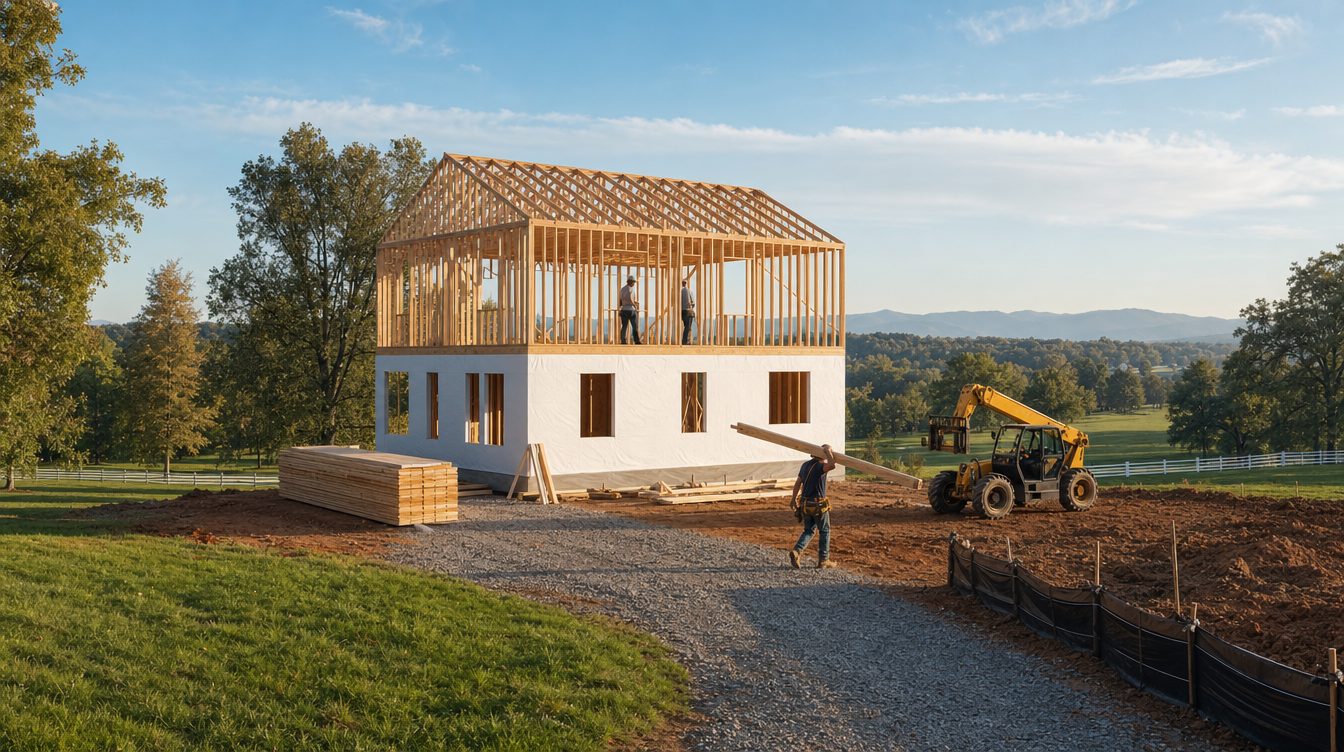
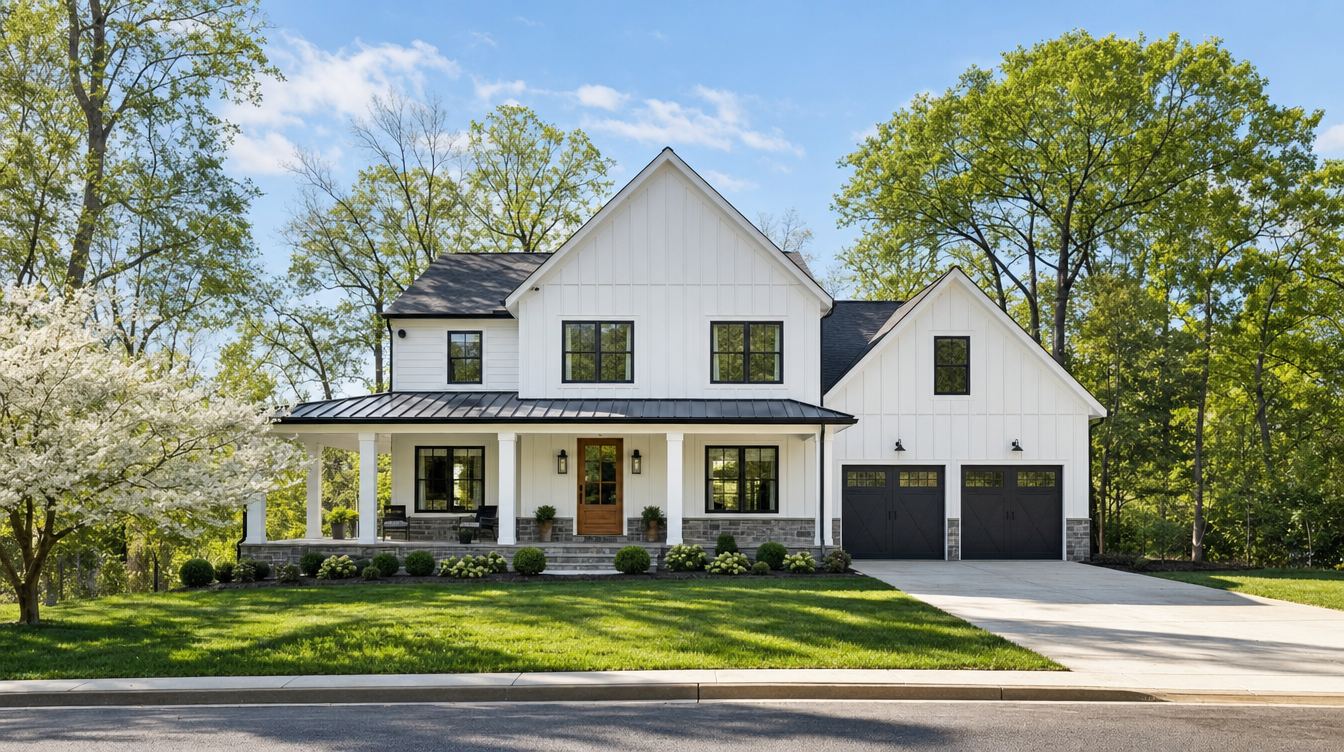
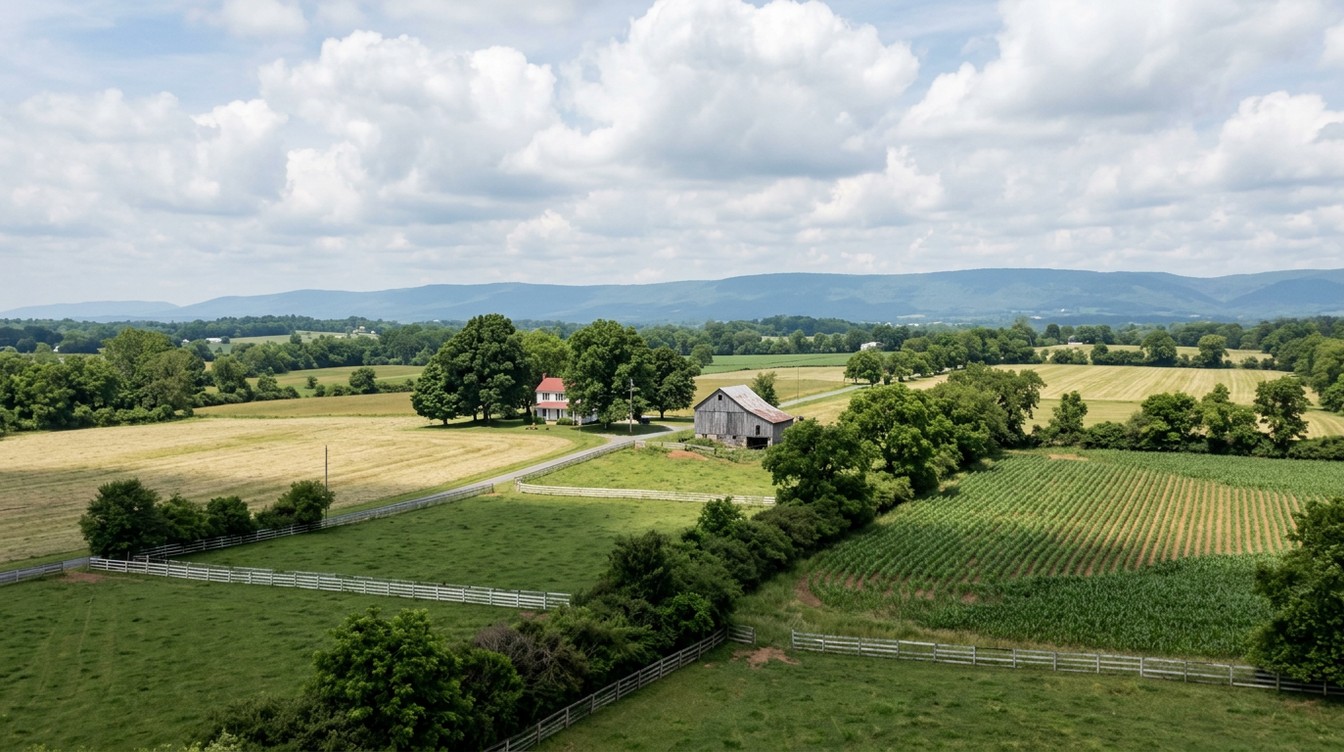
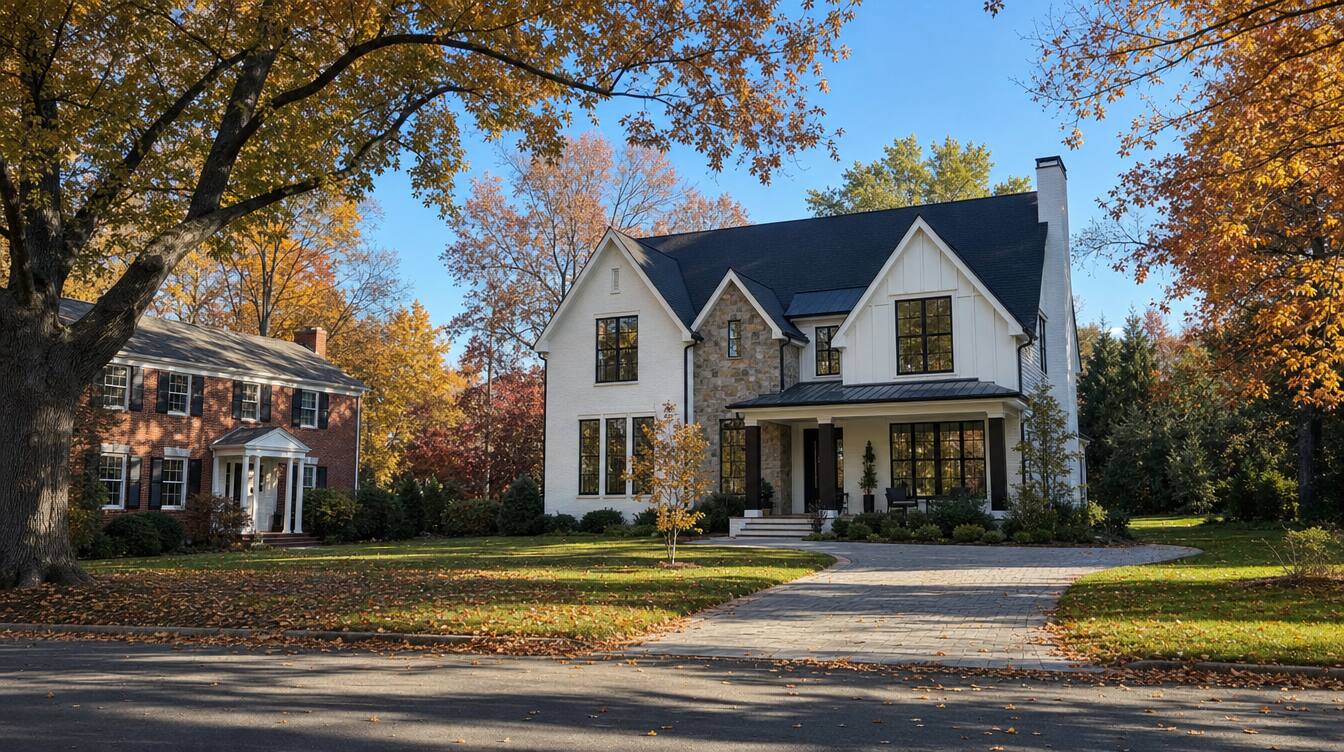
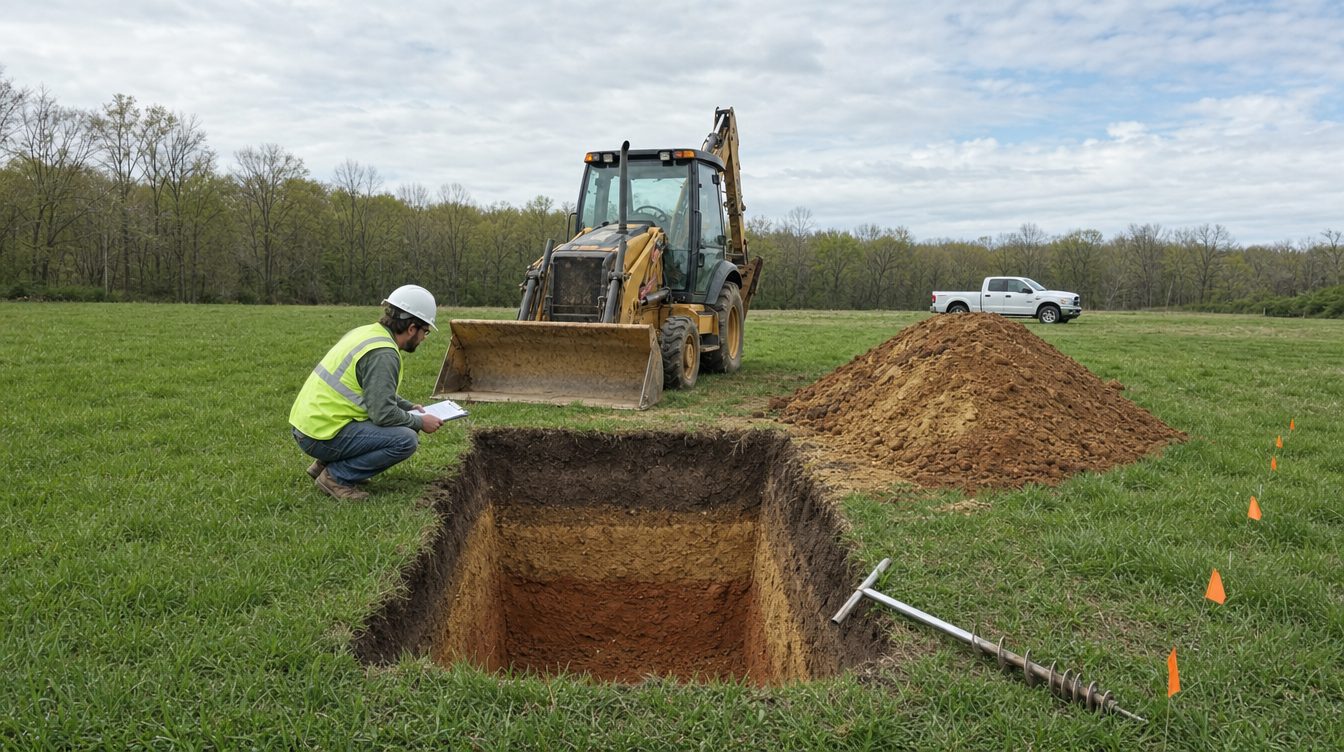
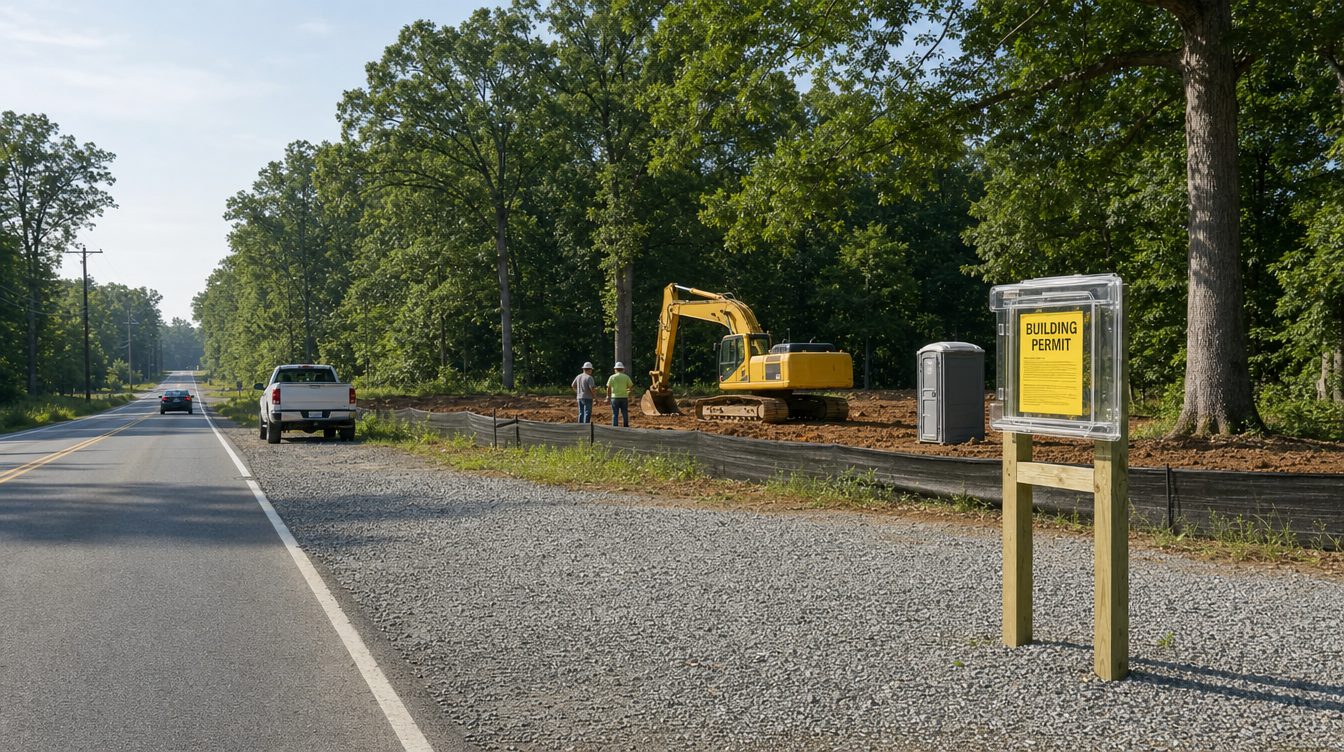
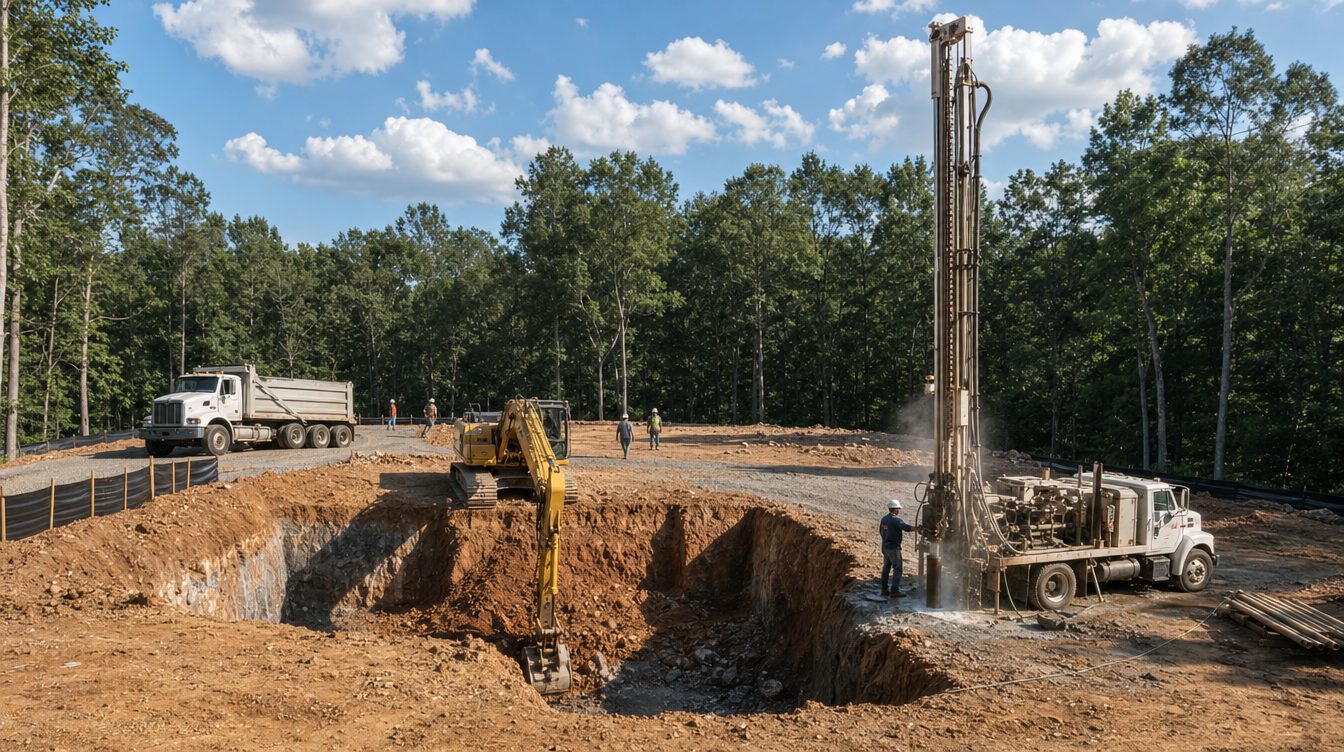
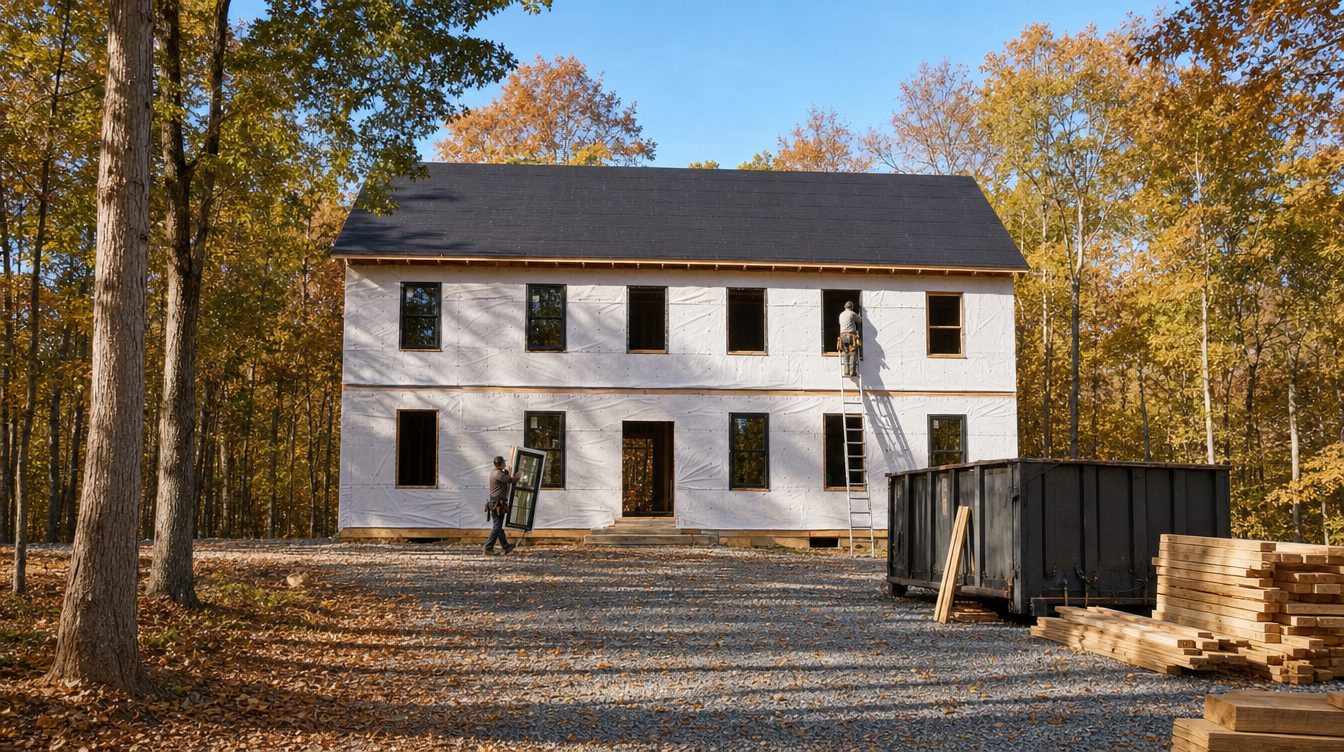
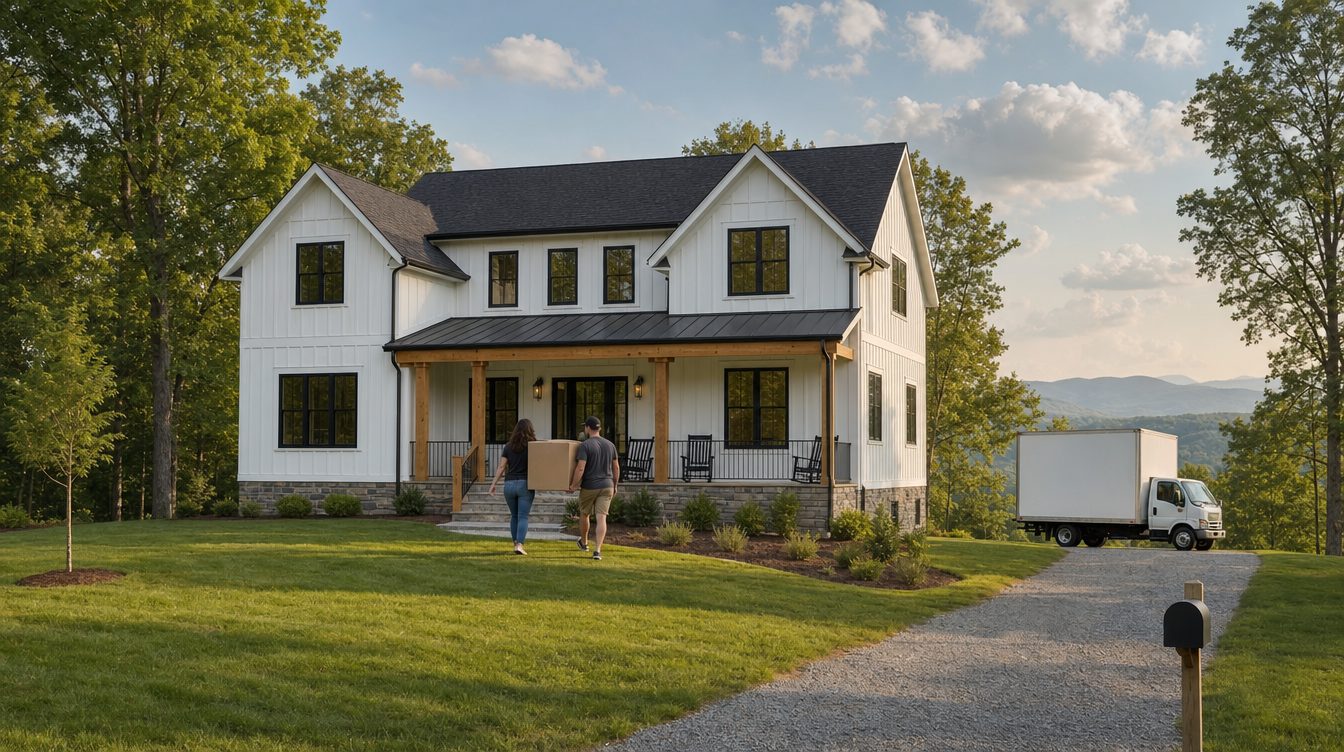
Pictures: artist’s renderings of real places. Numbers: Bright MLS (Ahmed’s pull, October 22, 2026), county and utility schedules, builders’ 2026 price guides.
Updated October 22, 2026Land and new-home prices: Bright MLS, last 12 monthsAbout a 14-minute read, plus the simulator
Quick answer
$500,000 will not buy land and build a 3,000 sq ft custom home here. NoVA builders' 2026 price guides start at $660,000 for the house alone.
Most mortgage lenders do not finance land or building. You need a lender that offers construction loans and pays the builder in stages.
With a hired builder, plan on about 11.7 months from permit to completion (Census, homes finished in 2025). Land, design and permits come before that.
The hard parts are perc and septic, zoning rules that change by county, water and sewer fees of $14,488 to $19,952, and finding the right loan.
Bright MLS (Ahmed’s pull, October 22, 2026), utility schedules, builders’ 2026 guides, Census
$975K+to build 3,000 sq ft at middle-range custom prices ($325-450 per sq ft), before land2
$195Kmedian sold homesite in Prince William, the lowest of the 4 counties; Fairfax: $900K6
$1.25Mmedian new 2,800-3,300 sq ft home sold in the 4 counties (116 sales)6
$14.5K+public water and sewer fees for one house: $14,488 Fairfax to $19,952 Loudoun, 20267,8,9
11.7 mopermit to completion, contractor-built homes on the owner’s land, U.S. 202512
6 moa permit can be revoked if work does not start, or stops, this long32
Builder prices are their own 2026 marketing figures, construction only. MLS medians cover homesites of 25 acres or less and leave out commercial land.
The honest math
The $500,000 question
The honest answer is no. In Northern Virginia, $500,000 cash will not cover land plus a 3,000 sq ft custom home. It can still be a strong start.
Step 1: the house. These are construction-only prices, before land, from NoVA builders' own 2026 price guides. They are sales material, not independent data.
Even the lowest tier costs more than $500,000 for the house alone. National numbers point the same way. NAHB's 2024 builder survey found an average construction cost of $428,215, about $162 per sq ft, for an average 2,647 sq ft home1. At 3,000 sq ft that comes to about $486,000 (our math), with no land and no Northern Virginia premium. For custom homes started in 2025 on the owner's land, the U.S. Census median was $171 per sq ft, not counting land74. That is $513,000 for 3,000 sq ft (our math).
Step 2: the land. These are median close prices for homesites (land of 25 acres or less). Source: Bright MLS, Ahmed's pull of October 22, 2026, last 12 months6.
Fairfax: $900,000, median lot 1.00 acre, 81 sales
Arlington: $761,000, median lot 0.20 acre, 12 sales
Loudoun: $584,500, median lot 4.87 acres, 44 sales
Prince William: $195,000, median lot 2.17 acres, 52 sales
Alexandria: 4 sales, too few to call
Step 3: hookups. Public water and sewer for one house costs $14,488 in Fairfax County. That is Fairfax Water's $5,090 (from April 1, 2026) plus county sewer at $9,398 (from July 1, 2026)8,9. With Loudoun Water it costs $19,952 (from January 1, 2026)7. On a rural lot, a well runs $6,000 to $16,000 and a septic system runs $7,000 to $40,000 or more. These are Virginia industry estimates55,56.
Step 4: soft costs and a cushion. One Fairfax cost guide estimates $20,520 for design, engineering and permits on a 2,500 sq ft house73. Lenders usually want a contingency of 5% to 10%71. A contingency is money set aside for surprises.
Put it together (our math):
Cheapest case we could source, Prince William: median lot $195,000, plus lowest builder tier $660,000, well $6,000, conventional septic $7,000, soil evaluation and permit $92554, design and permits $20,520, and a 5% contingency of $33,000. Total: about $922,000.
Middle case, Fairfax: median 1-acre lot $900,000 plus middle-tier construction, hookups, soft costs and a 5% to 15% contingency. Total: about $1.96 million to $2.50 million.
Neither case includes clearing, grading, driveway, electric line, insurance or loan interest.
What $500,000 can do:
Buy a lot, then borrow to build. If you already own the lot, Fannie Mae measures your loan against the home's "as completed" value. That is the appraised value of the finished house and lot15. In plain terms, the lot works like your down payment. FHA also lets land equity count toward its 3.5% minimum16,17.
Pay for the lot and the down payment together on a one-time-close loan that buys the lot at the same closing13.
Buy new. In the four counties, the lowest-priced new 2,800 to 3,300 sq ft detached home sold for $740,000. The median was $1,249,454 across 116 sales (Bright MLS, Ahmed's pull of October 22, 2026, last 12 months)6. $500,000 would be a large down payment.
Build smaller, or build where land costs less.
Try a scenario
Estimated total, land to move-in
Planning estimate, not a quote. Land: median sold homesite in each county, Bright MLS, Ahmed’s pull of October 22, 2026, last 12 months. Construction per sq ft: one Northern Virginia custom builder’s 2026 price guide, construction only. Hookup fees: the water utilities’ 2026 schedules. Well and septic, design and permits: published industry ranges. Loan interest: 12 months at 7.32% (Freddie Mac, October 22, 2026) on half the build cost; construction loans often cost more.2,6,7,8,9,10,23,55,56,73
Build or buy
Build it, or buy it new?
Builders are already putting up large new homes here. Buying one is often cheaper and always faster. Building makes sense when you want one particular piece of land or one particular design.
These are new detached homes built 2024 to 2026, with 2,500 sq ft or more above grade. Source: Bright MLS, Ahmed's pull of October 22, 2026, last 12 months6.
County
Sales
Median price
Median $ per above-grade sq ft
Median sq ft
Fairfax
281
$2,499,900
$535
4,832
Loudoun
169
$1,286,352
$400
3,217
Arlington
105
$2,460,000
$645
3,860
Prince William
45
$1,270,000
$298
4,088
How building compares (our math, rough):
Loudoun: median land at $584,500 plus middle-tier construction for 3,000 sq ft at $975,000 comes to $1,559,500, before hookups and soft costs. The median new Loudoun home sold for $1,286,352 at 3,217 sq ft.
Prince William: $195,000 plus $975,000 comes to $1,170,000 before extras. The median new home sold for $1,270,000 at 4,088 sq ft.
Fairfax: $900,000 plus $975,000 comes to $1,875,000 before extras. The median new home sold for $2,499,900 at 4,832 sq ft.
This is not a perfect match. MLS prices include the land, and the MLS price per sq ft counts only above-grade space. Builder quotes cover construction only. Land medians mix many lot sizes.
Bright MLS, Ahmed’s pull of October 22, 2026. Construction band: one Northern Virginia custom builder’s 2026 price guide, construction only, no land or site work.6,2
A to Z
From land to move-in: the 10 stages
Building here is a chain of ten stages, and each one waits on the one before. Each stage below shows who is involved, what to do and the trap to avoid.
Set the budget and talk to a lender
variesYou, construction lender, agent
Add up land, construction, hookups, soft costs and a contingency. Ask lenders whether they offer one-time-close loans. Time depends on how fast you can gather your paperwork.
Watch for: Assuming your usual mortgage lender also finances land and building.
Search for land
variesAgent who knows land
Compare lots by county, zoning, sewer and road access. Check whether the lot is on public water and sewer or needs well and septic. How long this takes depends on the market and how flexible you are.
Watch for: Trusting a builder website for zoning or lot-size rules.
Due diligence under contract
variesSoil evaluator, surveyor, agent, attorney
Order the perc test, survey and title search. Confirm zoning with the county and utility service with each provider. Timing depends on evaluator schedules and the weather.
Watch for: Closing before the soil results come back.
Close on the land
variesAttorney or title company, lender
Close with cash, a land loan, or as part of a one-time-close loan. Read every recorded easement and condition. Timing depends on the loan type.
Watch for: A short land loan with a balloon payment due before you build.
Design and engineering
variesArchitect, civil engineer, soil evaluator
Fit the house to the lot, the septic field and the setbacks. Get grading, stormwater and erosion plans drawn. Length depends on design choices and revisions.
Watch for: Designing more bedrooms than the septic permit allows.
Final loan approval
variesLender, builder, appraiser
Give the lender the builder contract, plans and budget. The appraisal values the finished house as planned. Timing varies by lender.
Watch for: A budget with no contingency, since a one-time-close loan amount is set once.
Permits
about 2 to 3.5 months in Fairfax, FY2022 to FY2024 averagesBuilder, county reviewers, health department
Submit plans for building, zoning, health and site review. Loudoun lists a 15-day building review after a completeness check of up to 10 business days. Prince William asks you to call for current times.
Watch for: An application left idle for 6 months is treated as abandoned.
Site work and utilities
varies; ask for gas at least 6 months aheadBuilder, well driller, septic installer, utilities
Clear, grade, build the driveway, and install erosion controls. Request electric and gas service early. Timing depends on soil, rock and utility schedules.
Watch for: Forgetting that you pay to run water and sewer lines to the main.
Construction
about 11.7 months from permit, contractor-built, U.S. homes finished in 2025Builder, subcontractors, county inspectors
The house goes up from footings to finishes. The lender pays the builder in stages after inspections. Keep inspections coming so the permit stays active.
Watch for: Change orders that use up your contingency.
Final inspections and move-in
variesBuilder, county inspectors, health department, lender
Pass final inspections and meet any recorded conditions. In Fairfax, the occupancy permit is the Residential Use Permit. Timing depends on inspection results.
Watch for: Unmet recorded conditions that hold up the occupancy permit.
Your team
Who you will need
You hire most of this team yourself, and early. Here is each role, when to bring them in and what to check.
Real estate agent who knows land: finds lots and writes the contract contingencies for perc, survey and financing. Hire first.
Construction lender: tells you what you can borrow. Talk to them before you make an offer. During the build, the lender pays the builder in stages13.
Soil evaluator (AOSE) or professional engineer (PE): does the perc and soil work and designs the septic. Hire during due diligence, before you close. They must be licensed through DPOR, Virginia's licensing agency51.
Land surveyor: maps the boundaries, slopes and setbacks. Hire during due diligence. Confirm their Virginia license.
Civil engineer: draws the grading, stormwater and erosion plans. Hire after closing, alongside the designer.
Architect or home designer: draws the house. Hire after closing, or earlier if you want a plan tested against the lot.
General contractor (builder): builds the house and usually pulls the permits. A contract of $150,000 or more needs a Class A license28. Check the license on DPOR's lookup.
Well driller: drills and tests the well, after permits.
Real estate attorney or title company: closes on the land and checks title, easements and recorded conditions. Hire when you go under contract.
Insurance agent: builder's risk coverage during the build. Ask your lender and insurer who must carry it.
Utilities: the water authority, the electric company and Washington Gas. Call them early, because gas can take up to 6 months61.
Lenders may also require your builder to be licensed, bonded and insured under state and local rules76.
Before you buy the land
AG
Real estate agentFinds land, checks zoning and sold prices, writes in perc and survey contingencies.
LN
Construction lenderPre-approves you for land plus build before you make an offer.
SE
Soil evaluator (AOSE) or engineerRuns the perc and soil test on rural land. Licensed by DPOR.
SV
Land surveyorMarks boundaries, easements, slopes and flood areas.
TA
Title attorney or settlement agentClears title, records the deed, checks covenants and proffers.
Design and permits
AR
Architect or home designerDraws the house to fit the lot, the budget and the code.
CE
Civil engineerGrading, stormwater, driveway and septic layout for the county.
BL
Builder (Class A license)Prices the plans; a whole house is over the $150,000 Class A line.
CO
County reviewersZoning, building, health (well and septic), site, and VDOT for a new driveway.
UT
UtilitiesWater and sewer, electric, gas or propane, internet. Apply early.
Build and move-in
TR
Licensed tradesElectric, plumbing, HVAC and gas, through your builder.
IN
County inspectorsFooting to final. No final, no occupancy permit.
HI
Your own home inspectorChecks each phase for you, before walls close.
DR
Lender's draw inspectorConfirms the work before each payment to the builder.
IS
Insurance agentBuilder's risk during the build, homeowners at move-in.
You sit in the middle: 15 roles, and on a custom build you make the calls that connect them.
Routes
Three ways to build
Most people hire one builder for everything. Virginia lets you be your own builder, but the rule is narrow and lenders rarely like it.
1. A custom builder on your lot. One licensed firm holds the contract and the permit. This is the route lenders handle most easily. It is also faster. In Census data for homes finished in 2025, contractor-built homes took about 11.7 months from permit to completion. Owner-built homes took 14.3 months12.
2. A design-build firm. Design and construction come under one contract, so there are fewer handoffs. The tradeoff is less room to take the design to other builders for prices. Some production builders also offer fixed plans on your lot. In Fairfax, plans based on a builder's approved master plan get only a quick review before a permit is issued (FY2022 county report)35.
3. Your own builder, with subcontractors.
The rule: Virginia Code § 54.1-1101 lets you build without a contractor license, but only one primary residence in any 24-month period26.
The live-in test: state contractor board guidance says you must live in the home once it is done, with a family exception. If you build to sell, you need a license27.
Selling early: you need a certificate of occupancy before you sell, unless the buyer agrees in writing to buy without one26.
Fairfax paperwork: if no licensed contractor is listed on the permit, you file a License Exemption Affidavit30. The county strongly recommends that a licensed contractor pull the permits31.
Trade work: sources disagree on whether you may do your own electrical, plumbing, HVAC or gas work. Ask the county building office and DPOR before you plan on it. Any trades you hire must be licensed.
FHA: you may act as general contractor only if you are a licensed general contractor16. One FHA information site says it knows of no FHA lenders that let borrowers do their own work81.
Fannie Mae: you must hold title to the lot83, and the lender manages payments to the builder13.
Zoning
The rules change by county
What you can build depends on where the land is. A rule from one county can be wrong a few miles away.
Area
Typical rural lot rule
Sewer
What to watch
Loudoun (AR-1, AR-2)
AR-1: 1 lot per 20 acres base, 1 per 5 acres cluster. AR-2: 1 per 40 acres base, 1 per 15 cluster (county GIS, December 12, 2023)41
Builder websites list wrong lot minimums. Cluster rules changed March 12, 202542
Prince William (A-1)
New lots at least 10 acres, with some exceptions43
29 of 52 noted septic or perc6. In unserved areas, you pay to extend water and sewer mains64
The rural crescent plan protections ended in December 202244. Digital Gateway rezonings were voided August 5, 202645
Western Fairfax (Occoquan watershed, R-C)
One house per 5 acres in the Watershed Protection Overlay46. R-C: 5-acre minimum, 200 ft wide, no clustering (older ordinance copy)47
Occoquan land in the Fairfax planning district is outside the approved sewer area (2006 plan text)48. 35 of 81 noted septic or perc6
Fairfax has a new zoning ordinance, so check current sections. Health Department review applies if the lot is on well or septic29
Arlington and the cities
Small lots. Arlington's median sold lot was 0.20 acre across 12 sales6
Mostly public. City of Fairfax sewer fee: $7,972 per unit, date not shown11
Arlington's Expanded Housing Option (EHO) rules still apply as of May 20, 202649. Ask each city about lot coverage
MLS counts: Bright MLS, Ahmed's pull of October 22, 2026, last 12 months.
Loudoun: the zoning ordinance adopted December 13, 2023 is the one in force40. Read the official text or call Loudoun Zoning before you buy.
Rezonings can be undone. In Prince William, the Digital Gateway rezonings were voided and the land went back to its old zoning. The plan amendment stayed in place45.
Erosion rules: a local plan covers work that disturbs 10,000 sq ft or more. In a Chesapeake Bay Preservation Area, the trigger is 2,500 sq ft65. A single house may use a signed agreement instead of a full plan66.
Proffers are conditions agreed to in a rezoning. Building one house by right does not bring new ones67. Recorded conditions on a rezoned subdivision still must be met before Fairfax issues the occupancy permit29.
Soil
Perc, well and septic, in plain words
With no public sewer, the soil decides how big a house you can build, or whether you can build at all. Test it before you close.
Perc test: checks how water moves through the soil, so a septic field can work.
Who does it: you hire and pay a private AOSE or PE. The health department accepts their work50. The health department does its own evaluation only through a hardship petition51.
Cost: $800 to $1,600 per evaluation, from one Virginia builder's 2026 guide56. A Virginia septic permit guide puts all permitting at $925 to $1,700. It says Northern Virginia evaluators often charge $800 to $1,20054.
Alternative system (AOSS): a treatment unit for soil that does not perc well. It costs $20,000 to $40,000 or more55, plus about $200 to $700 a year in upkeep80. These are industry estimates.
Loudoun rules: Chapter 1040 covers wells, Chapter 1066 covers onsite sewage and Chapter 1067 covers alternative systems. Alternative systems need yearly inspection and reporting52. Owners must pump the tank at least once every 5 years53.
Well: $6,000 to $16,000, depending on depth (builder estimate)56.
If the land fails: you may need an alternative system, a smaller house with fewer bedrooms, or you may not be able to build. Make your contract depend on the soil results.
Simplified drawing, not to scale. Alternative systems add a treatment unit between the tank and the drainfield and, in Loudoun, a yearly inspection.52,53
Utilities
Utilities: hooking up the land
Raw land rarely comes with water, power and gas. Each one has its own fee, its own forms and its own wait.
Running the pipe costs extra. In Loudoun, the owner builds the water and sewer lines from the house to the public main63. In Prince William, owners in unserved areas pay to extend the mains64. Ask Fairfax Water whether service connection or local facilities charges apply to your lot84.
Electric, Dominion: lines to your property normally go overhead at no cost. If you want or need underground lines, you pay extra57.
Electric, NOVEC: there is no line extension charge for standard single-phase service, except for underground work58. You need a recorded easement and a county wiring inspection before NOVEC connects you59. On a 2013 form, NOVEC said design and invoice take 1 to 4 weeks60.
Gas: Washington Gas asks for your request at least 6 months ahead61. If the new line will not bring in enough revenue, you may pay a share of its cost62. With no gas main nearby, your choices are a propane tank or an all-electric home with a heat pump.
Internet: we have not checked broadband programs. Ask providers about the exact address before you buy.
The budget
Where the money goes
Most of the money goes into the house. The small lines are where budgets break.
A 3,000 sq ft home, middle finish level, on a lot with public water and sewer, before the land
Construction $325-450 per sq ft x 3,000$1,162,500
Contingency (10%) 5-15% is the usual advice$116,250
Construction loan interest estimate, 12 months$42,548
Water and sewer hookups $14,488 Fairfax to $19,952 Loudoun$17,220
Total before land$1,362,401
Middle of each sourced range. Not included: clearing, grading, driveway, rock, stormwater, electric line runs, builder’s risk insurance, land closing costs.2,7,8,9,71,72,73
In NAHB's 2024 national survey, construction was 64.4% of the average sales price and the finished lot was 13.7%1.
Costs people forget:
Survey, soil evaluation, civil engineering and architect
Permits. One third-party guide says plan on $4,000 to $9,000 for a new Fairfax home73
Water and sewer fees, plus running the lines
Clearing, grading, driveway, electric line and stormwater work
Rural site work. One NoVA design-build firm quotes $150,000 to $400,000 for site infrastructure on rural estate land5
Builder's risk insurance, title costs and construction loan interest
Contingency. Lenders usually want 5% to 10%71. One builder suggests 15% to 20% or more when the soil or access is uncertain72
Yearly upkeep if you end up with an alternative septic system80
Financing
Paying for it: do all lenders finance land and building?
No. Most mortgage lenders sell their loans soon after closing. A construction loan cannot be sold until the house is finished.
Fannie Mae will not buy a one-closing construction loan until the build is done. Until then, the lender pays the builder in stages13. That is why you need a lender that keeps these loans itself. Local and regional banks and credit unions are often named, but ask each lender directly.
LTV means loan-to-value: the loan divided by the home's value.
Jumbo: the 2026 high-cost ceiling for conforming loans is $1,249,12522. A loan above your county's limit is a jumbo loan. Check FHFA's county table.
Rates: the 30-year fixed averaged 7.32% on October 22, 2026, down from 7.40% the week before. A year earlier it was 6.19% (Freddie Mac survey)23.
Bank standards: in Q2 2026, banks reported construction and land standards basically unchanged. That survey is mostly about developer loans24.
If you are short on cash:
Buy the land first, build later. Watch for short land loans with balloon payments25. A balloon payment is a large lump sum due at the end.
Seller financing: have a Virginia attorney review it.
HELOC on your current home: you could lose the home if you miss payments, and the new payment can lower what you qualify for78.
Bridge loan: one financial planner cites rates of 7% to 11% plus 1.5% to 3% in closing costs78.
Gifts: Fannie Mae allows gift funds under set conditions77.
Builder rule for VA: VA no longer requires a VA builder ID number. State and local licensing still applies19.
Timeline
How long it really takes
With a hired builder, about a year from permit to completion. Before that come months of land search, testing, design and review.
Building: in Census data on homes finished in 2025, contractor-built homes took about 11.7 months from permit to completion. Owner-built homes took 14.3 months. The South Atlantic region, which includes Virginia, averaged 7.6 months for all homes12.
Fairfax permits: in FY2022, the county approved 874 single-family permits in an average of 103 days35. A third-party summary of the FY2024 report says 67 calendar days36. A June 2026 local news report says new-home reviews took about 13 business days37. The county's own timing figures leave out outside agencies such as Health and Zoning82.
Loudoun permits: a completeness check takes up to 10 business days. Review then takes 15 days for the building permit and 10 days for zoning. The county does not say whether those are business or calendar days38.
Prince William permits: the county asks you to call Building Plan Review at 703-792-6930 for current times39.
Site plans: a law firm summary says state law cut local review of site and subdivision plans from 60 to 40 days, starting July 1, 202579.
Loan clocks: Fannie Mae allows no single construction period over 12 months and no more than 18 months in total13. USDA limits construction to 12 months21.
Before the permit: we found no official figure. Expect months.
Rough math: about 2 months of Fairfax permit review plus about 12 months to build comes to roughly 14 months, after the land and design are done.
Permits
If the project stalls: permits that expire
Virginia permits do not last forever. Keep the work moving and the inspections coming.
Applications: an application is treated as abandoned 6 months after filing, unless you are actively pursuing it or the permit has been issued32.
Issued permits: the building official may revoke a permit if work does not start within 6 months, or if work stops for 6 months32.
Showing progress: it is on you to prove real progress, for example one approved inspection within 6 months32.
Extensions: on written request, the building official may grant extensions of up to one year each32.
Trade permits: plumbing, electrical and mechanical permits are not revoked while the building permit is still in effect33.
Code changes: plans approved under an older code edition stay valid while the permit is not suspended or revoked34. A revoked permit may lose that protection.
Compared
Northern Virginia vs simpler places
If you have built before, somewhere else, it may have felt simple. Here it is a regulated, step-by-step process.
Texas, for contrast: in 2009 Texas abolished its residential construction commission. Counties got only limited power to enforce building codes outside cities68. In one survey, only 2 of 10 responding coastal Texas counties had a building code for those areas69.
Virginia: one statewide building code, enforced locally. A locality without a building department must arrange enforcement through another locality or an approved agency70. No part of Virginia is code-free.
Northern Virginia adds layers: health review for well and septic, site and grading review, VDOT when the lot is on a state road, and zoning29.
The balance
Challenges and opportunities
Building here is hard, and it is also possible. Here is the balance.
What makes it hard
Construction alone starts at $660,000 for 3,000 sq ft, using the lowest 2026 builder tier2
Zoning differs by county, and some websites get it wrong
Septic soil can shrink the house or end the plan
Few lenders offer construction loans
Water and sewer fees of $14,488 to $19,952 come before you run any pipe7,8,9
A permit can be revoked after 6 months with no work32.
Your checklist
The big checklist: land search to move-in.
54 steps in 6 stages. Tick them off as you go; your ticks stay on this device. Print it for your folder or your builder.
0 of 0 done
Money first
Before you buy land
Due diligence and closing on land
Design and permits
The build
Move-in
Your ticks stay on this device only. Nothing is sent anywhere.
Questions
What people ask about buying land and building here.
Can I build a house with $500,000 in Northern Virginia?
Not land plus a 3,000 square foot custom home. NoVA builders' 2026 price guides start around $220 per square foot for construction alone, which is $660,000 before land. You can still use $500,000 to buy a lot and use it as equity on a construction loan, or put it toward buying a new home. The lowest new 2,800 to 3,300 square foot home in Ahmed's October 2026 MLS pull sold for $740,000.
Do all mortgage lenders finance land and construction?
No. Most lenders sell their loans soon after closing, and a construction loan cannot be sold until the house is finished. Until then, the lender holds the loan and pays the builder in stages. Look for lenders that offer one-time-close construction loans. These are often local or regional banks and credit unions, but ask each lender directly.
How long does it take to build a custom home in Northern Virginia?
Census data on homes finished in 2025 shows about 11.7 months from permit to completion for contractor-built homes and 14.3 months for owner-built homes. Before that come land search, soil testing, design and permits. Fairfax new-home permits averaged 103 days in FY2022. Plan on more than a year from land to move-in.
Can I be my own general contractor in Virginia?
Yes, within limits. Virginia lets you build one primary residence in any 24-month period without a contractor license, and you must live in it when it is done. If you build to sell, you need a license. FHA allows it only if you are a licensed general contractor, and few lenders accept owner-builders. Ask the county and DPOR before doing your own trade work.
What happens if my building permit expires in Virginia?
The building official may revoke a permit if work does not start within six months, or stops for six months. You must show real progress, such as an approved inspection. You can ask in writing for extensions of up to one year each. A revoked permit may lose its protection under the older code edition, so new plans could have to meet the current code.
How much does it cost to connect water and sewer in Loudoun County?
Loudoun Water's availability fees for a home with a three-quarter-inch residential meter are $8,592 for water and $11,360 for sewer, for a total of $19,952. Those rates took effect January 1, 2026. On top of that, the owner pays to build the water and sewer lines from the house to the public main. Check the current rate page before you budget.
What is a perc test and who does it in Virginia?
A perc test checks how water moves through the soil, so a septic system can work. In Virginia you hire a private licensed soil evaluator or a professional engineer, and the health department reviews the work. The health department does its own evaluation only on a hardship petition. One Virginia builder's 2026 guide puts the cost at $800 to $1,600.
How much does a septic system cost in Northern Virginia?
Industry estimates put a conventional septic system in Virginia at $7,000 to $15,000. An alternative system, used when soil does not perc well, can cost $20,000 to $40,000 or more, plus about $200 to $700 a year in upkeep. In Loudoun, alternative systems need yearly inspections, and every septic tank must be pumped at least once every five years.
How much down payment do I need for a land loan?
Industry sites say raw land often needs 30 to 50 percent down, while improved lots with utilities and road access may need 15 to 25 percent. No federal agency publishes typical land loan terms, so each lender sets its own. Land loans are often short, five to twenty years, and some end with a large balloon payment.
Is it cheaper to build or buy a new home in Northern Virginia?
Often it is cheaper to buy new. In Ahmed's October 2026 MLS pull, the median new Loudoun home sold for $1,286,352. Median Loudoun land plus mid-range construction for 3,000 square feet comes to about $1,559,500 before hookups and soft costs. Building makes sense when you want a particular piece of land or a particular design.
Your next step
Thinking about land? Start with the numbers.
Send me the lot or the area you have in mind. I will pull the sold land and new-home numbers around it and tell you what the build really looks like. English or Arabic, real numbers, not a pitch.