
10 things most homeowners don’t know about their own homeNorthern Virginia, checked at the source: November 2026
The sewer pipe under your lawn is yours. Your county’s record of your home can be wrong. And a standard policy leaves out flood.
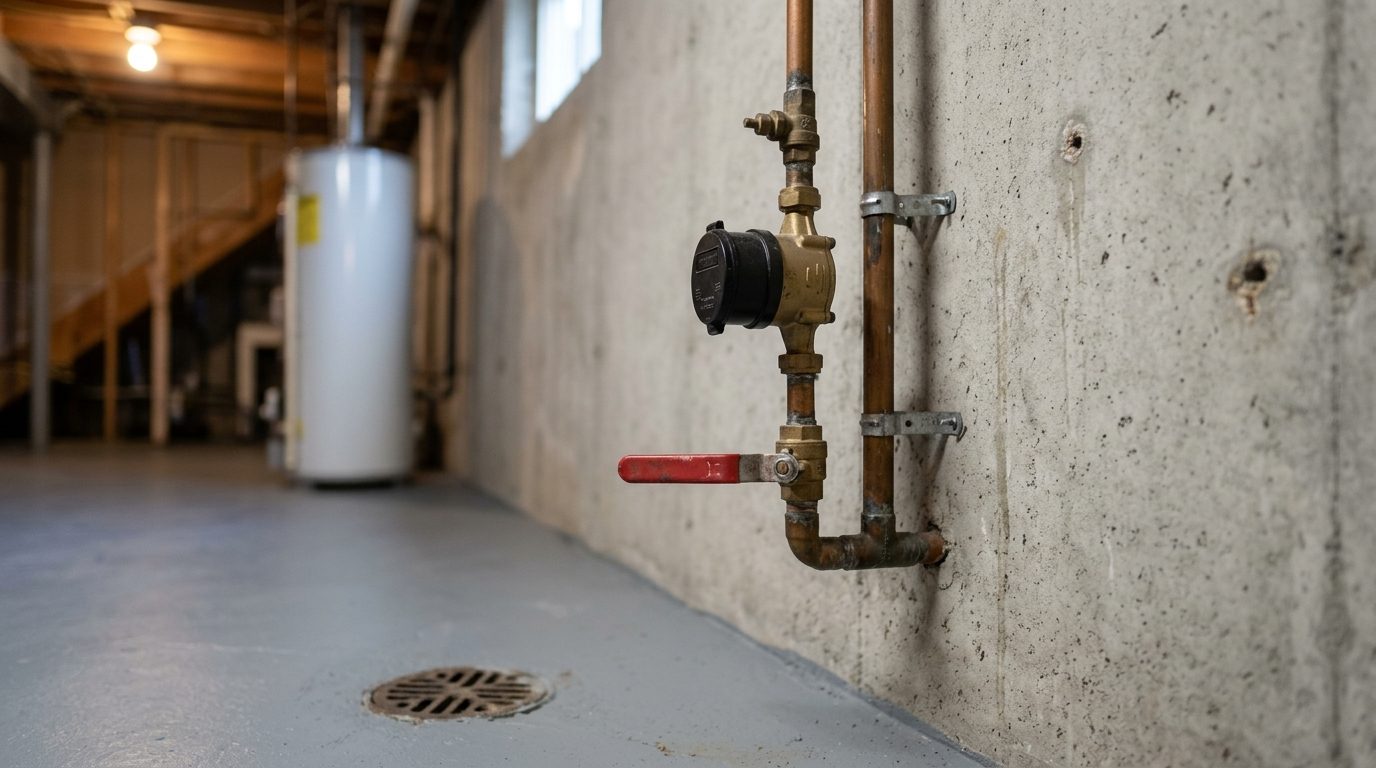
Know where your water shuts off· Fairfax County
Checked at official sources November 5, 2026.
Quick quiz
Know your home?
If the sewer pipe between your house and the street main breaks, the county fixes it.
Your score
Tap true or false. Each answer opens right here, with what to do, and all ten are explained below with their sources.
Updated November 5, 2026Every fact checked at its source November 5, 2026A 2-minute quiz, plus a 7-minute read
Quick answer
Most Northern Virginia owners own more than they think and are covered for less. In Fairfax County the sewer pipe to the street main is yours, and so is the water pipe from the meter1,2. Fairfax County is in the EPA’s highest radon zone8. More than 20% of flood claims come from outside high-risk zones, and homeowners insurance doesn’t normally cover flood10. Your county record and permit history are public4,15, and owners 65+ can get up to 100% off Fairfax real estate tax16.

Your home, in four numbers
Each from its official source
General facts from public sources, not advice for any one home. Your county, your utility and your policy have the final word.
1 of 10 · Under your yard
The pipes under your lawn are yours, not the utility’s.
If the sewer or water pipe under my yard breaks, the county or the water company fixes it.
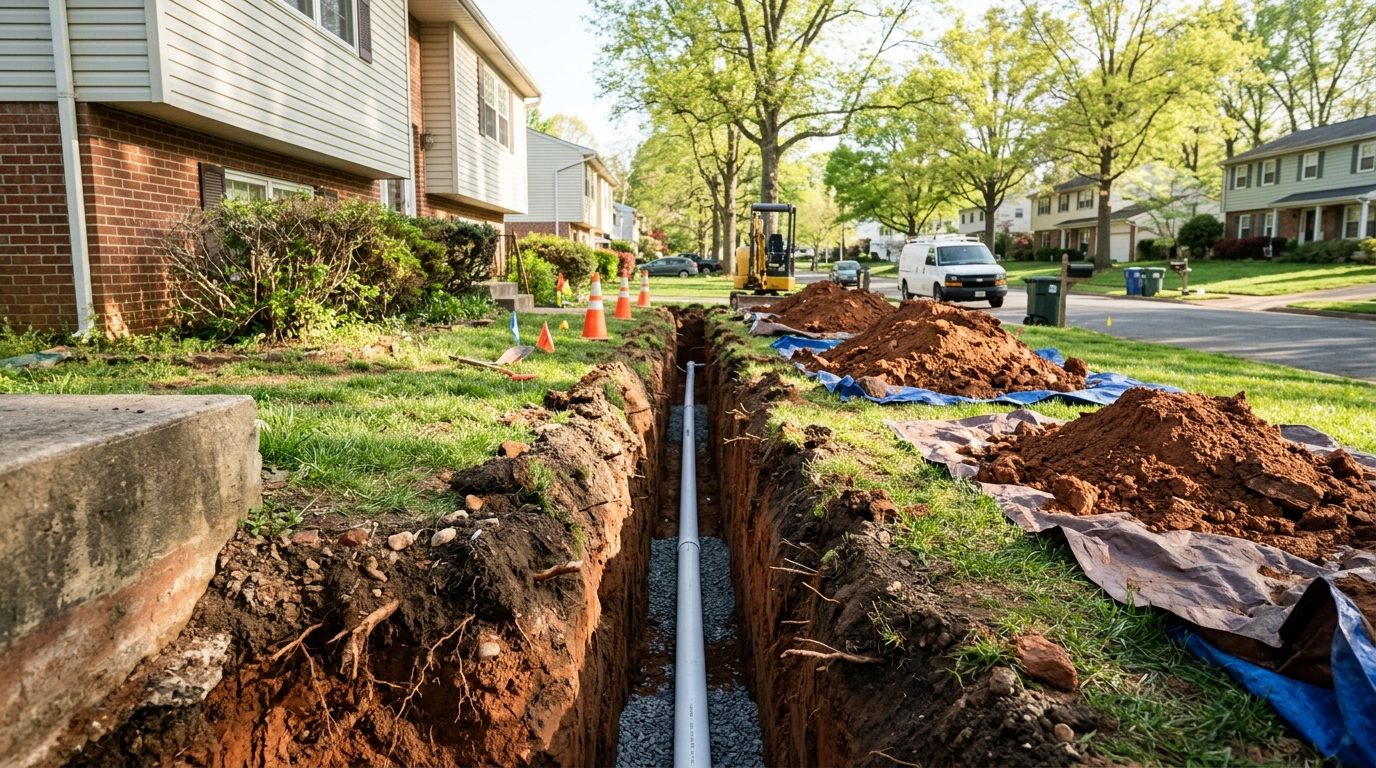
In Fairfax County, the sewer pipe is yours all the way to the public main, and the water pipe is yours from the meter to the house.
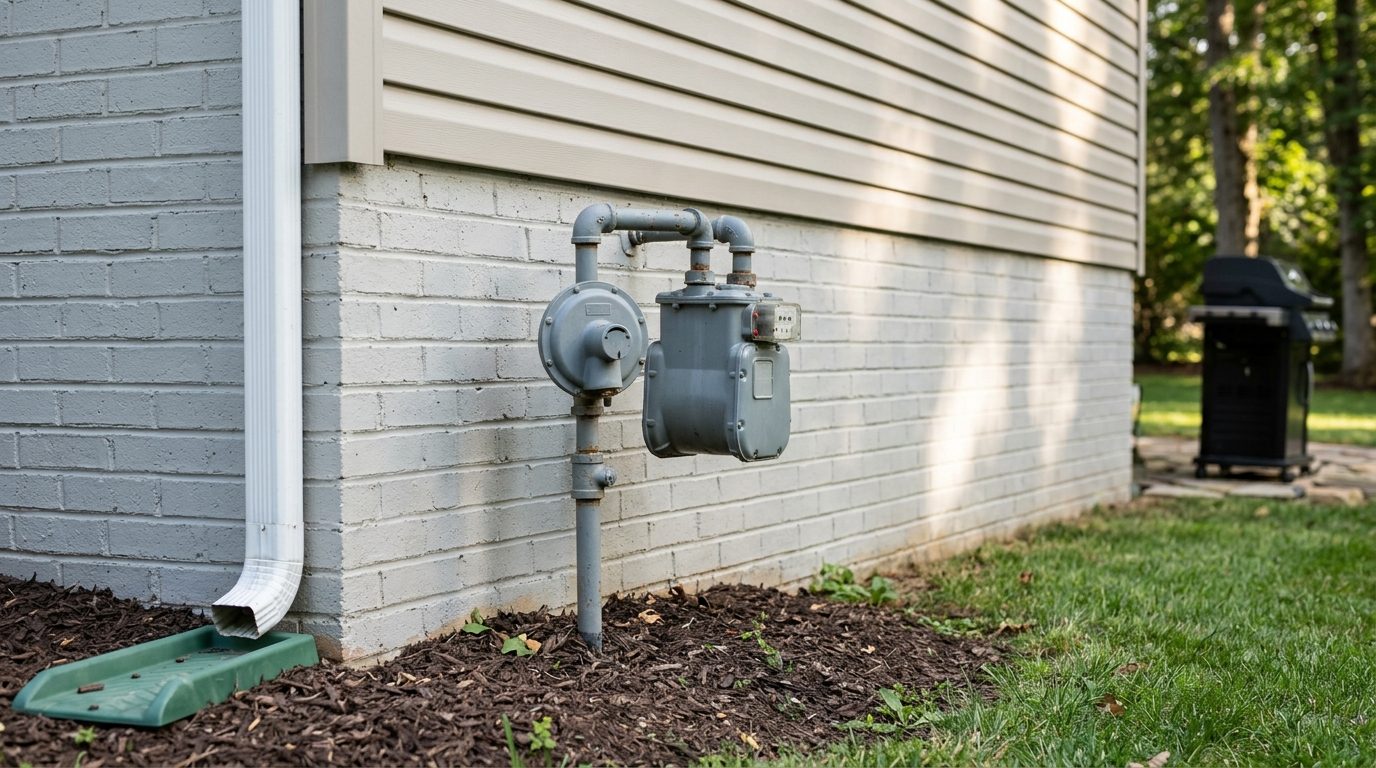
Fairfax County puts it plainly: maintaining, repairing and replacing the sewer pipe from your house to the public main is the property owner’s job1. Fairfax Water owns the meter; the pipe from the meter near the street to the main valve inside your house is part of your plumbing2. And federal law makes the gas company tell you, once, in writing, that it does not maintain buried gas pipe on your side of the meter, like a line to a grill, pool heater or detached garage3.
Other counties and cities set their own lines, so ask your water and sewer utility where its part ends.
Tap a pipe above. Red is yours to fix. Navy belongs to the utility.
Drawing, not to scale. “M” is a meter. Fairfax County and Fairfax Water rules, plus the federal gas rule.
- Find your main water shutoff valve, usually where the water line comes through the foundation2, and make sure it turns.
- Find your sewer cleanout (often a capped pipe near the house) so a plumber can reach the line without digging.
- Ask your insurance agent whether your policy covers the pipes under your yard. Many owners never ask.
2 of 10 · Your tax bill
The county keeps a public file on your home, and it can be wrong.
My assessment is just the county’s opinion. I can’t do anything about it.
Anyone can read your home’s county record. If the size, baths or basement are wrong, you can ask for a fix, and every county has an appeal deadline.
Every Northern Virginia county posts each home’s record online: year built, living area, bedrooms, baths, basement and its value, plus nearby sales. Fairfax County’s steps: search your address in the real estate assessment database, open Values for past assessments and Neighborhood Sales to compare4.
If something is off, there are two steps. First a simpler review with the county’s assessment office, then, if you still disagree, the Board of Equalization. The deadlines are strict: Fairfax County says there are no exceptions4.
- Year built
- 1987
- ✓ right
- Living area
- 2,140 sq ft
- ? check
- Bedrooms
- 4
- ✓ right
- Full baths
- 2
- ? check
- Basement
- Unfinished
- ? check
The county values your home partly from these facts, so a wrong one can move your assessment.
2026 appeal deadlines
- MonMar 2Arlington: ask the county to review6
- MonMar 16Loudoun: ask the Commissioner of the Revenue to review5
- WedApr 1Fairfax County: administrative appeal4
- WedApr 15Arlington: Board of Equalization6
- MonJun 1Fairfax County and Loudoun: Board of Equalization4,5
- WedJul 1Prince William: Board of Equalization7
Navy = the first, simpler step with the county. Red = the Board of Equalization, an independent board. The 2027 dates come with the 2027 assessments.
- Look up your home: Fairfax County, Loudoun, Arlington, Prince William.
- Check the living area, baths and basement against what you really have.
- Put next year’s appeal date on your calendar when the 2027 assessments come out.
3 of 10 · The air inside
Fairfax County is in the EPA’s highest radon zone.
Radon is a problem somewhere else, not in Northern Virginia.
The EPA puts Fairfax County in Zone 1, its highest radon zone, and a test kit costs Virginians $3.
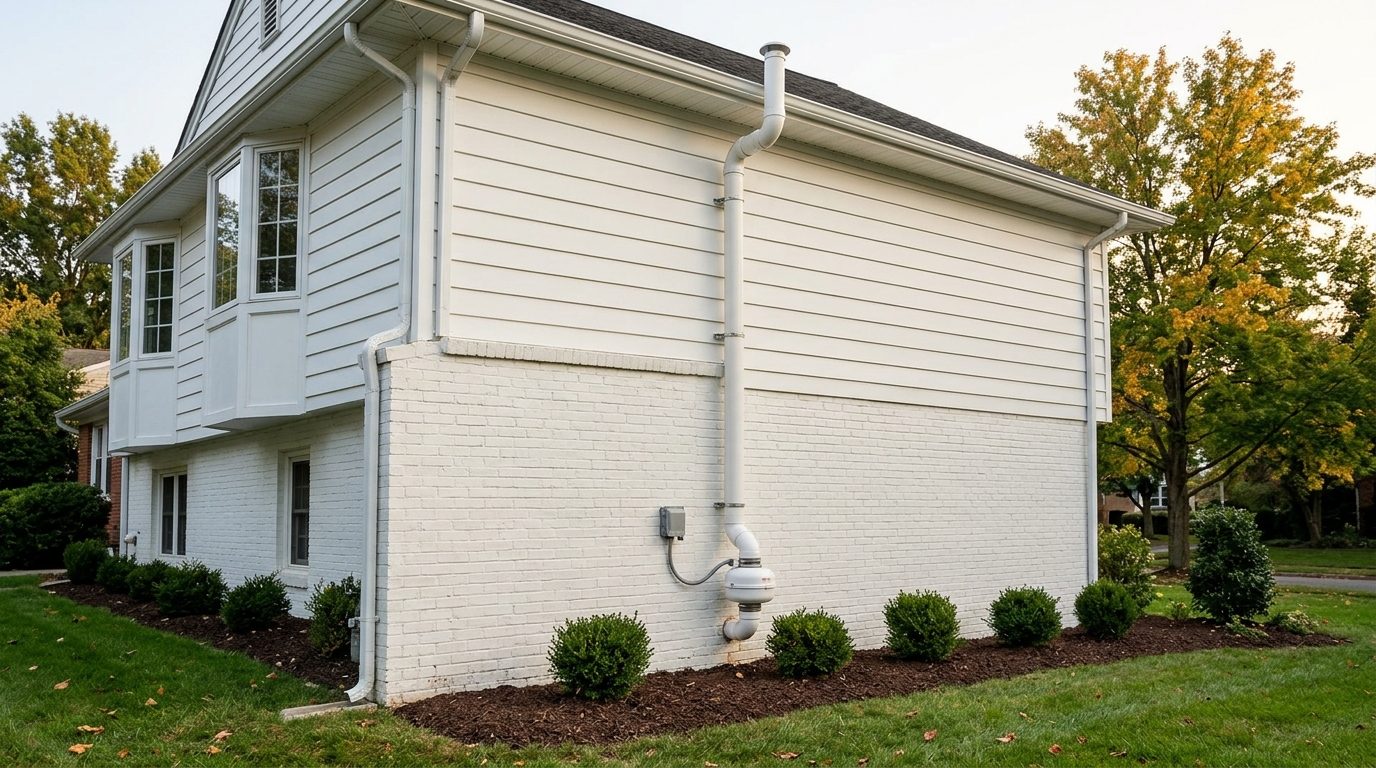
Radon is a gas you can’t see or smell. It comes up from the ground and can collect in a house, most of all in basements. The U.S. Surgeon General calls indoor radon the second-leading cause of lung cancer in the U.S.8
The Fairfax County Health Department says the EPA rates the county’s radon potential as Zone 1, the highest8. The Virginia Department of Health says Loudoun should be rated high risk too9.
EPA radon zones: where Fairfax County sits
In plain words. The zone is a predicted average for the whole county, not your house. Two houses next door can test very differently, so the EPA says every home should be tested, whatever its zone9. Fix at 4 pCi/L (picocuries per liter of air) or more8.
- Order a $3 test kit for Virginia residents (Fairfax County Health Department page)8, or buy one at a hardware store.
- Test in the lowest room you live in, like a finished basement.
- At 4 pCi/L or more, get a radon mitigation system.
4 of 10 · Water from outside
More than 1 in 5 flood claims comes from outside a high-risk flood zone.
I’m not in a flood zone, so flood isn’t my problem. And my homeowners policy covers water anyway.
People outside high-risk zones file more than 20% of flood insurance claims, and homeowners policies don’t normally cover flood.
FEMA’s own numbers: people outside high-risk flood zones file more than 20 percent of all claims to the National Flood Insurance Program, and homeowners policies “do not normally cover flood damage”10.
Flood insurance is not only for homes near the Potomac. Flash floods follow small streams and storm drains, and a new policy usually takes 30 days to start10.
Where flood insurance claims come from
In plain words. Of every 5 flood insurance claims in the U.S., more than 1 comes from a home outside a high-risk flood zone10. Heavy rain and backed-up storm drains don’t read the flood map.
- Look up your home on my Northern Virginia flood zone map.
- Ask an agent for a flood quote; outside high-risk zones it is often lower.
- Buy before storm season: the 30-day wait starts when you pay.
5 of 10 · Water from inside
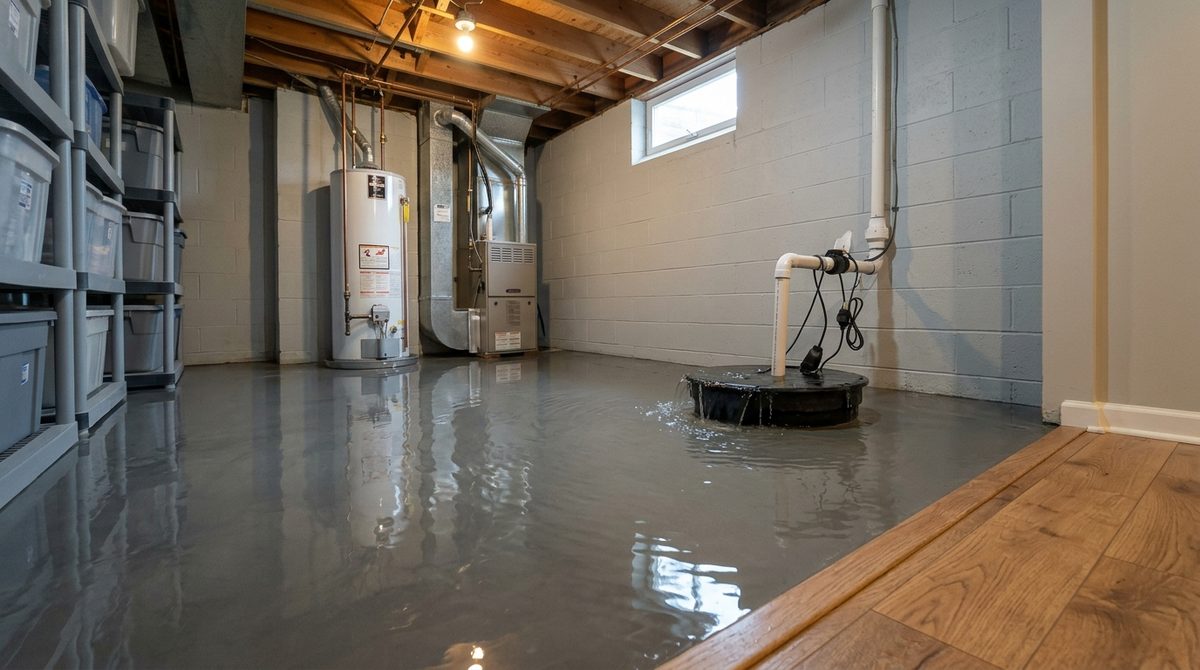
Water that backs up through a drain may not be covered.
If sewage or water backs up into my basement, my homeowners policy pays.
Virginia makes insurers offer water and sewer backup coverage, but you may have to add it and pay extra.
The Virginia Bureau of Insurance says companies “are required by law to offer you water and sewer back-up coverage”, and that you “may have to pay extra” for it11. Offered is not the same as included. It is a line many owners never look for until a floor drain or sump overflows.
The same guide says a homeowners policy generally does not cover floods or earthquakes11.
What a standard Virginia homeowners policy leaves out
From the Virginia Bureau of Insurance homeowners guide11. Your own policy’s wording is what counts.
- Open your policy and search for “water backup” or “sewer backup”.
- If it is missing, ask your agent what it costs to add, and how much it pays.
- If you have a sump pump, ask about a battery backup.
6 of 10 · Your back yard
A stream near your lot can put part of your yard off limits.
It’s my yard. I can clear the trees by the creek or put a shed back there.
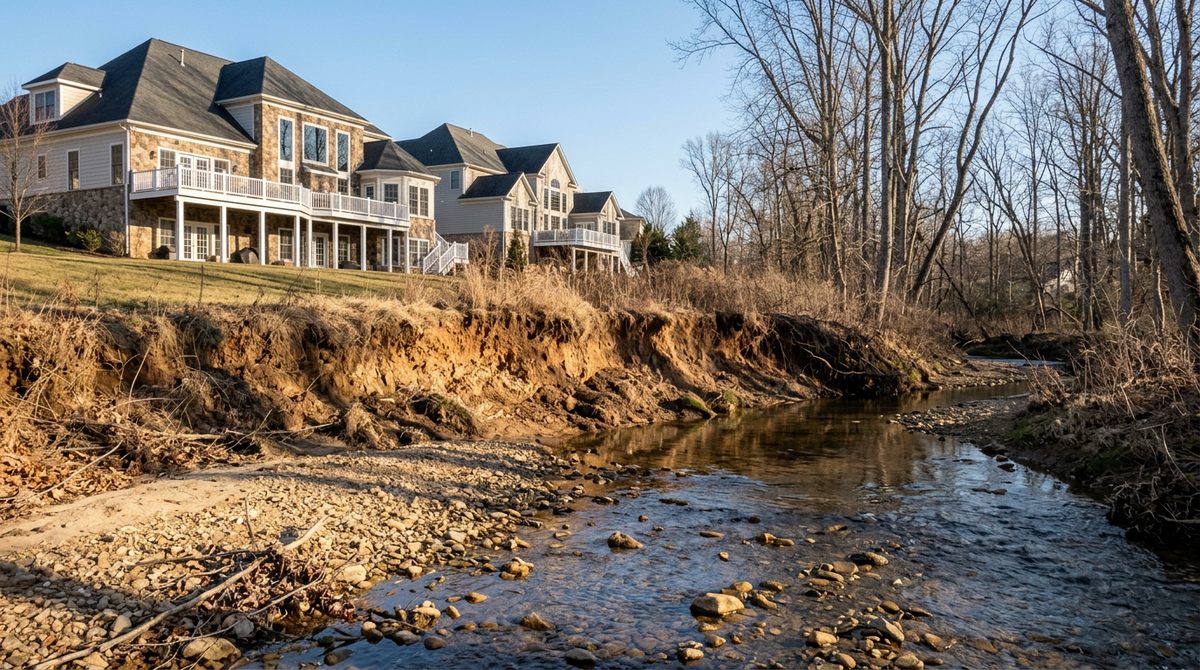
Near a stream with year-round flow, a 100-foot buffer limits clearing and building, even on private land.
Virginia’s Chesapeake Bay rules protect a strip along streams called a Resource Protection Area. In Fairfax County it reaches 100 feet from streams with year-round flow and other water features. Clear-cutting is not allowed, and sheds, gazebos, pools and detached garages generally need an exception after a public hearing. What was there before the rules can stay, but can’t grow12.
The Bay Act covers Arlington, Fairfax and Prince William counties and the cities of Alexandria, Fairfax and Falls Church. Loudoun County, Manassas and Manassas Park are not on the state’s list13.
Example lot, not to scale. Check your own lot on the county map.
- Fairfax County: type your address in the county’s Watershed and Resource Protection Area viewer, or call 703-324-172012.
- Before cutting trees, adding a patio or shed near water, ask the county first.
- Buying near a creek? Check the buffer before you plan the yard.
7 of 10 · Before you dig
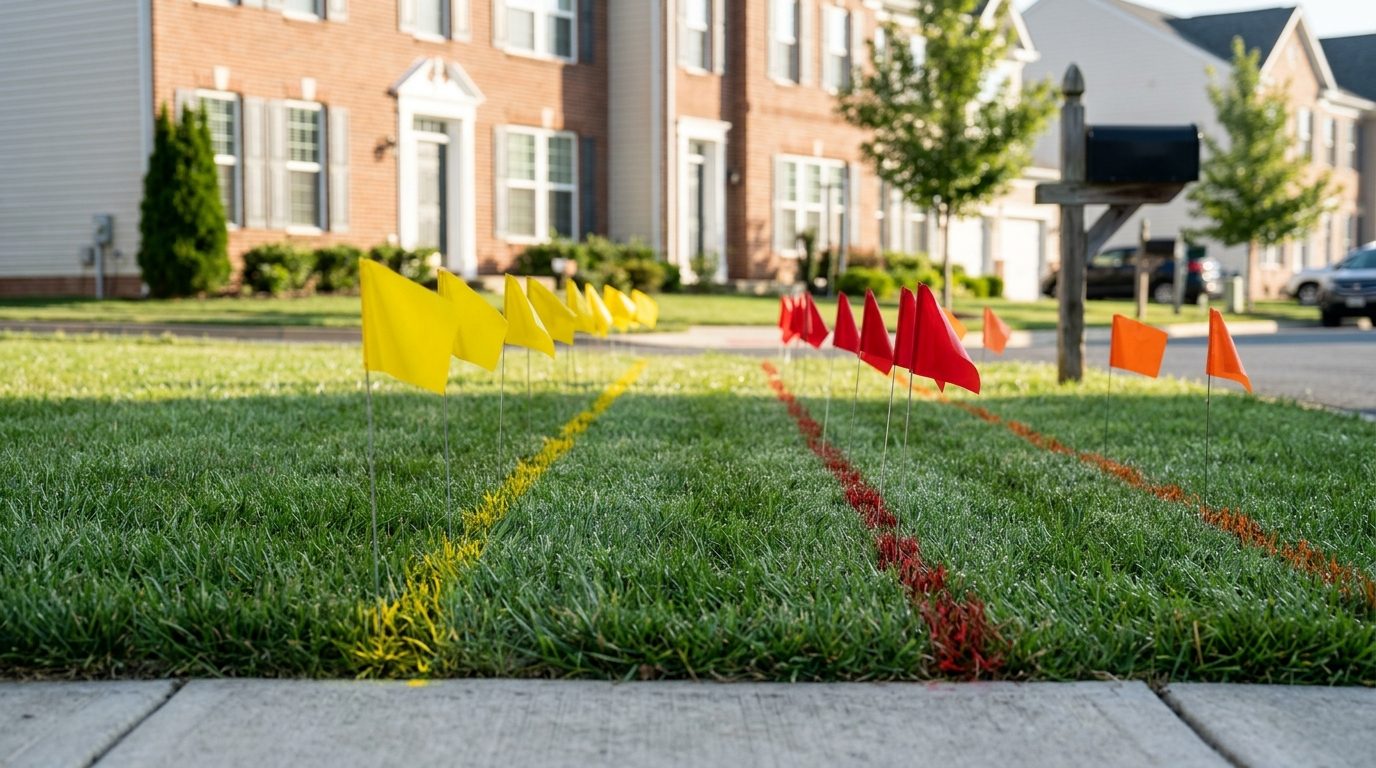
Calling 811 before you dig is the law, even to plant a garden.
811 is for contractors with big machines. I’m just putting in a fence post.
Anyone digging should contact Virginia 811 at least 3 working days ahead. It’s free, and many lines sit a few inches down.
Virginia 811 says contacting it before you dig “is the LAW”, that there is no set depth before you need to, and that many utilities are buried “just a few inches below the surface”. A new fence, a mailbox, a garden or an old stump all count, and the service is free14.
One more surprise: 811 marks the public utility lines. Pipes that are yours, like the buried gas line to a grill, are not on its map, and the gas rule says to find them before you dig and dig near them by hand3.
Called 811 on a Friday? Here is how the 3 working days count
Weekends and legal holidays don’t count. Dig after every line is marked.
In plain words. Contact 811 at least 3 working days before you dig, not counting weekends or legal holidays. It costs the homeowner nothing14.
- Contact Virginia 811 online or by calling 811, 3 working days before you dig.
- Wait for the flags or paint, then dig by hand near them.
- Ask a plumber or your gas company to find the private lines that are yours.
8 of 10 · The paper trail
Your home’s permit history is public.
What a past owner built is between them and the county.
Anyone can search Fairfax County’s permit system without an account, and Loudoun’s too.
Fairfax County’s permit system, PLUS, can be searched with no account15. Loudoun’s LandMARC lets anyone search public records such as permits15. Decks, finished basements, additions and big electrical or plumbing jobs usually leave a record.
If a past owner finished a basement or built a deck without a permit, you want to know before you sell or refinance, not when a buyer asks.
One house’s permit story (example)
- 1987House builtPermit on file
- 2004New deckPermit on file
- 2015Basement finishedNo permit found
- TodayYou look it up, before anyone else doesFree
An example to show the idea, not a real address.
- Search your address: Fairfax County PLUS or Loudoun LandMARC. Other places: ask the county or city permit office.
- Keep your own folder: permits, final inspections, plans.
- Planning work? See which projects need a permit in Fairfax County.
9 of 10 · Money back
Many owners 65+ and disabled veterans pay little or no real estate tax.
Real estate tax relief is only for people with very low incomes.
In Fairfax County, owners 65+ with household income up to $90,000 a year can get 25% to 100% off. Veterans rated 100% disabled pay $0.
Fairfax County’s 2026 limits: you (or your spouse) are 65 or older, or permanently and totally disabled; household income is $90,000 a year or less; and net assets are $400,000 or less, not counting the home. Relief runs from 100% at $60,000 or less down to 25% at $80,001 to $90,00016.
Veterans with a 100% service-connected, permanent and total rating pay no real estate tax on the home they live in and up to one acre17.
Fairfax County 2026: slide your household income
Household income for the year before, a year. Owners 65+ or permanently and totally disabled, net assets $400,000 or less not counting the home16.
Veterans rated 100% disabled
real estate tax on the home they live in and up to one acre, for veterans rated 100% service-connected, permanent and total. Some surviving spouses qualify too17.
This exemption is statewide. Loudoun, Prince William and Arlington run their own senior relief with their own limits: see their tax pages below.
- 65+ or disabled? Apply with your county; returning Fairfax County applicants filed by May 1 in 202616.
- See the relief rules for Fairfax, Loudoun, Prince William and Arlington.
- Tell a parent or neighbor who might qualify. Many never apply.
10 of 10 · Your HOA
You have a legal right to see your HOA’s books.
The HOA board decides what owners get to see.
Virginia law gives a member in good standing the right to look at and copy the HOA’s books and records.
Under Virginia’s Property Owners’ Association Act, the association’s books and records are open to a member in good standing, or someone the member authorizes, for a proper purpose. Send a written request: an HOA with a management company has 5 business days, a self-managed one 10. Copy charges can’t be more than the actual cost18.
That is how owners see the budget, the reserve study and the contracts their dues pay for.
How long your HOA has to open its books
In plain words. Send a written request. Once the clock runs out, a member in good standing gets to look at and copy the records, for a proper purpose. Copies can cost no more than the HOA’s actual cost18.
- Ask in writing (email is fine to keep a record) for what you want to see, like the budget or reserve study.
- Keep the date you sent it; the 5 or 10 business days start then.
- Buying in an HOA? See the townhouse guide for typical dues.
Your list
Your 10-step home check.
Tick them off as you go. Your ticks stay in this browser only; nothing is sent anywhere.
Questions
What owners ask about their homes.
Who pays if the sewer pipe between my house and the street breaks?
In Fairfax County, the owner. The county says maintaining, repairing and replacing the sewer pipe from the house to the public main is the property owner's responsibility, and the repair needs a county plumbing permit. Other counties and cities set their own rules.
Do I need flood insurance if my home isn't in a flood zone?
Lenders usually don't require it outside high-risk zones, but FEMA says people outside those zones file more than 20 percent of flood insurance claims, and homeowners policies don't normally cover flood. A new policy usually starts 30 days after you pay.
How do I test my home for radon in Northern Virginia?
Use a home test kit in the lowest room you live in. The Fairfax County Health Department says kits cost Virginia residents $3, and to fix the home at 4 pCi/L or more.
When can I appeal my real estate assessment?
Each county sets its own dates. In 2026: Arlington review by March 2 and Board of Equalization by April 15; Loudoun review by March 16; Fairfax County administrative appeal by April 1; Board of Equalization by June 1 in Fairfax and Loudoun and by July 1 in Prince William.
Can my HOA refuse to let me see its records?
Not if you are a member in good standing asking for a proper purpose. Virginia Code 55.1-1815 gives the HOA 5 business days after a written request (10 if self-managed), and copy charges can't be more than the actual cost.
Your next step
Want a second set of eyes on your home’s records?
I’ll pull your county record, flood zone and nearby sales and walk you through what they mean for your home. In English or Arabic, with no cost and no pressure.
اقرأ هذه الصفحة كاملة بالعربية ←
وكيلك العقاري الموثوق في شمال فرجينيا.
Keep exploring
Your next pages.
Northern Virginia flood zone map
Your FEMA flood zone by address, and what it costs.
HomeHow old is my water heater?
Read the age off the label, and what to expect.
PermitsFences, sheds and decks
What needs a permit in Fairfax County.
TaxesFairfax County property tax
Rates, due dates, appeals and relief, 2026.
Try a free tool
See all 39 free tools →- Just saw a house? Quick factsType the address of a house you just saw: size, value range, community sales, schools, noise, flood zone and sun on one screen.
- Homes sold near me: 1-mile radarType any address: every house and townhouse sold within 1 mile, the median price and the latest sales.
- Buying power calculatorStart from the payment. Tax, insurance and HOA included.