Tenant and Landlord Rights in Northern VirginiaWhat to do when repairs, deposits or rent go wrong, step by step
Tap tenant or landlord, then what is going on. See your next step, the day count and who to call.
Renting in Northern Virginia· Burke, Fairfax County
Rules: the Code of Virginia, checked October 27, 2026. Pictures: artist’s renderings of real places.
Start here
Tenant or landlord? Tap yours.
What is going on? Tap the one that fits
General information from the Code of Virginia, checked October 27, 2026. Not legal advice. Nothing you tap or type is saved or sent.
Your answer comes with the next step, the day count, the law and who to call in your county.
Law checked October 27, 2026Rechecked every June, after the General AssemblyA 20-second tool, plus a 10-minute read
Quick answer
In Virginia almost every fix starts with a written notice. Tenants: once the landlord has your letter, they get 14 days before you may hire a licensed contractor and take the cost off rent, and 21 days before you can end the lease.1 Landlords: unpaid rent takes a written 14-day notice (since July 1, 2026), then court, never a lockout.7,5 Deposits come back within 45 days.3 Tap tenant or landlord above for your next step.
14 daysa landlord has to fix after a tenant’s written repair notice, before repair and deduct1
45 daysto return a security deposit, with an itemized list of anything kept3
$5,000+what an illegal lockout or utility shutoff costs a landlord, one-time (or 4 months’ rent, if more)5
25,665eviction cases filed in Fairfax, Prince William, Alexandria, Arlington, Loudoun and Falls Church in 202511
1.4%of Virginia tenants in eviction cases have a lawyer (median by court, October to December 2025)11
69%of Northern Virginia eviction judgments were defaults: the tenant did not come (July to December 2025)11
Day counts start when the other side receives the written notice. Eviction counts: court filings, 2025.
Who to call
Free help in your county or city.
Pick where the home is. Every number here is free to call.
In shortStart with the free options: county mediation, code enforcement and legal aid.
Numbers read on each office’s own page or the county page that lists it, October 27, 2026. Manassas Park: call the city’s main line for code questions; the state and legal aid numbers above work everywhere.13
Tenants: repairs
When the landlord drags their feet on repairs.
The law gives you a ladder, and every step starts with a letter.
In shortWrite it down, then count: 14 days to repair and deduct, 21 days to fix or the lease can end, 30 days and a judge presumes the delay is too long.
The repair path in one picture. The letter starts the clock; on day 14 you may bring in a licensed contractor.1
Day 0
Written notice
A dated letter: what is broken, where, since when. Keep a copy and photos. Texts or the app count only if your lease allows electronic notices.
Day 14
Repair and deduct
Hire a licensed contractor (or licensed pest company), pay, give the landlord an itemized statement with receipts, and take it off rent: up to one month’s rent or $1,500, whichever is more (one-time).
Day 21
Fix deadline
If you sent a 21/30-day notice for a health or safety breach and it is not fixed, the lease ends on the date in your notice, at least 30 days after the landlord got it.
Day 30
Rent escrow
In General District Court, more than 30 days is presumed unreasonable. You pay rent into court, not to the landlord. Through December 31, 2026 that is all rent due, within 5 days of each due date; from January 1, 2027, rent that comes due during the case.
6 months
Still not fixed?
If the landlord has not made reasonable efforts within 6 months, the court must pay the escrowed rent to the tenant.
A city or county inspector is the free, fast option alongside all of this: a violation notice from code enforcement also counts as notice for rent escrow, and since July 1, 2026 localities can go to court for tenants over serious health and safety problems.1
Pests and mold are the tenant’s to report: tell the landlord the day you see them. A tenant who waits can be charged for the extra treatment.1
Repairs ignored
Quick answerPut it in writing first. Once your landlord has your written notice, the clocks start: 14 days, then you may hire a licensed contractor and take the cost off your rent (up to one month’s rent or $1,500, whichever is more). 21 days to fix before you can end the lease. After 30 days a judge presumes the wait is too long.
Write it down. A dated letter that says what is broken, where, and since when. Keep a copy and photos.
Give the landlord time. Allow access with notice. Many fixes happen here.
Day 14: repair and deduct. Hire a licensed contractor (or licensed pest company), pay, give the landlord an itemized statement and receipts, and take the cost off rent: up to one month’s rent or $1,500, whichever is more.
Call code enforcement. A county or city inspector can cite the landlord. Their violation notice also counts as notice for rent escrow.
Day 21 to 30: end the lease or go to court. A written 21/30-day notice can end the lease if the landlord does not fix it. Or file a “tenant’s assertion” (rent escrow) in General District Court and pay rent into court, not to the landlord.
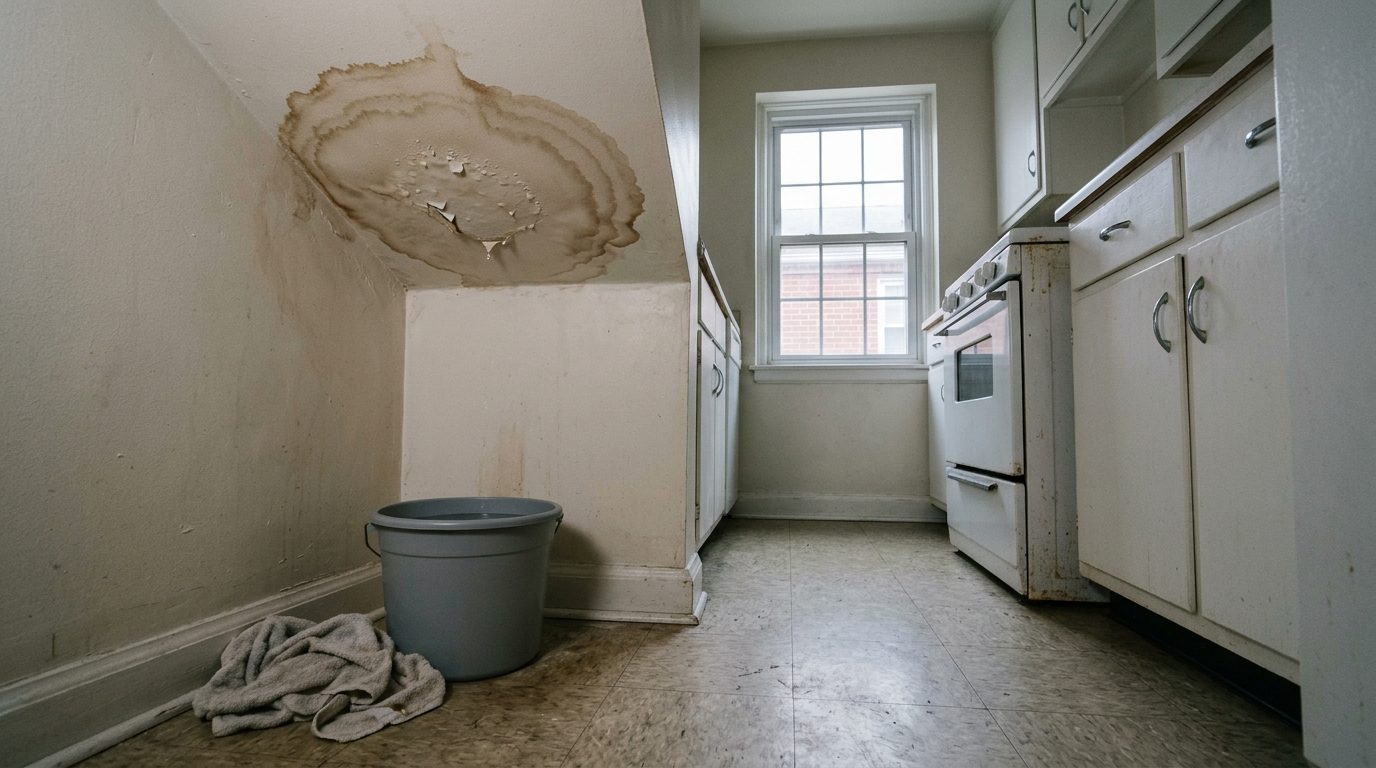
A leak that waits gets worse. Write it down the day you see it. A concept image.
Tenants: the letter
Write your repair notice in one minute.
Fill four boxes. The letter appears below, ready to copy or print. Nothing is sent to us.
In shortA good letter is short and dated: what, where, since when, and how to reach you. No threats needed.
Your letter
Hand it over and ask for a dated signature on your copy, or mail it to the address in your lease. Email or the app counts only if your lease allows electronic notices.2
The letter starts every clock. Keep a copy and the photos. A concept image.
Both sides: the deposit
The deposit: 5 days, 72 hours, 45 days.
The three dates that decide most deposit fights.
In shortThe deposit can’t be more than 2 months’ rent, and it comes back within 45 days with a list of anything kept.
The deposit clock. Inspection within 72 hours of move-out; money and the itemized list within 45 days.3
Move-in
Damage list in 5 days
The landlord lists existing damage within 5 days of move-in.
+5 days
Object in writing
You have 5 days to add what the list missed, or it is deemed correct. Take photos too.
Move-out
Inspection in 72 hours
The landlord inspects within 72 hours and must tell you that you may be there.
45 days
Deposit back
With an itemized list of deductions. Willful failure: the deposit plus actual damages and attorney fees.
Deposit not returned
Quick answerYour landlord has 45 days after you move out to return the deposit, with an itemized list of anything kept. If they willfully don’t, a court can order the deposit back plus your actual damages and attorney fees.
Quick answerInspect within 72 hours of getting the home back (the tenant may attend), then return the deposit within 45 days with an itemized list of deductions. Normal wear and tear is not damage. Willful failure: the deposit back plus actual damages and attorney fees.
In shortYour landlord needs 72 hours’ notice for routine maintenance, can never lock you out, and can’t punish you for complaining.
Landlord comes in without notice
Quick answerYour landlord may enter at reasonable times with notice, and needs at least 72 hours’ notice for routine maintenance you did not ask for. No notice is needed in an emergency or for a repair you requested. Repeated or harassing entry lets you seek a court order, end the lease, and recover damages.
Quick answerThat is illegal without a court order. Ask the General District Court for an order the same day: the first hearing is within 5 days. If you win, the landlord owes your actual damages plus $5,000 or four months’ rent, whichever is more (one-time), and your attorney fees.
Stay safe. Call the police non-emergency line if you are locked out; call 911 if anyone is in danger.
Go to General District Court. File a petition for a lockout or utility shutoff. The judge can order the landlord to let you back in or turn service back on.
Call legal aid. Legal Services of Northern Virginia can help with the petition.
Quick answerA landlord may not raise rent, cut services, or threaten or file for eviction because you complained to code enforcement, complained to them, joined a tenants’ group or testified. Starting January 1, 2027 the protection also covers fair housing complaints, complaints to the media, new fees and harassment. A normal market-rate increase is still allowed.
Quick answerUsually you owe rent until the lease ends or a new tenant moves in, whichever comes first, and the landlord must try to re-rent. Military orders and victims of family abuse, sexual abuse or stalking have special rights to leave early.
Quick answerA late fee is allowed only if the lease says so, and can’t be more than 10% of the monthly rent or 10% of the balance owed, whichever is less. Since July 1, 2026 a lease can’t make you pay for maintenance or repairs you did not cause. Starting July 1, 2027 you can ask for a full statement of charges and payments.
Garden apartments in Buckingham, Arlington, in May. The same rules cover every rental in Virginia. A concept image.
Tenants: court papers
Got eviction papers? Here is the timeline.
What happens from the notice to the sheriff, and where you can still stop it.
In shortMost eviction judgments here are defaults: the tenant didn’t come. Go to court, and call legal aid first.
Day 0
14-day notice
Written pay-or-quit notice. Pay within 14 days and the lease goes on.
Day 15+
Case filed
Unlawful detainer in General District Court; the summons is served at least 10 days before the hearing.
≤ 21 days
First hearing
Within 21 days of filing (30 at most). Go. You can pay everything owed by this date to end the case.
+10 days
Appeal window
10 days to appeal. The sheriff cannot evict before it ends.
72 hours
Sheriff’s notice
Posted at least 72 hours before the eviction. Paying all amounts up to 48 hours before still stops it.
I got eviction court papers
Quick answerGo to court on the date on the summons. In Northern Virginia about 7 in 10 eviction judgments in late 2025 were defaults, where the tenant did not show up. If it is about rent, you can usually stop the case by paying everything owed (rent, late fees, court costs and attorney fees) by the first court date, or later, up to 48 hours before the sheriff comes.
Call legal aid today. Legal Services of Northern Virginia: 703-778-6800.
Go to the hearing. Bring the lease, receipts, photos and letters.
Ask about paying to stay. “Redemption”: pay all amounts owed, or bring a written promise of payment from an agency to the first hearing for 10 more days.
If you lose. You have 10 days to appeal. The sheriff must post a notice at least 72 hours before an eviction and cannot evict before the 10-day appeal period ends.
Unpaid rent, damage, lease breaks: the legal path.
Notices, then General District Court. Each card has the day counts.
In shortNotice first, then court: a written 14-day notice for rent, a 21/30-day notice for other breaches, and never self-help.
Never lock out, shut off utilities or remove belongings. Without a court order it is illegal in Virginia, and the tenant recovers actual damages plus $5,000 or four months’ rent, whichever is more, and attorney fees.5
Rent not paid
Quick answerGive the tenant a written 14-day pay-or-quit notice (it was 5 days until July 1, 2026). If rent is still unpaid, file an unlawful detainer in General District Court. Never change the locks, cut utilities or remove belongings: that costs at least $5,000 or four months’ rent, whichever is more.
Give the Statement of Tenant Rights first. You cannot file a lease-violation case until the tenant has received it with the lease (§ 55.1-1204).
Serve the 14-day notice. In writing: the rent is unpaid and the lease ends if it is not paid within 14 days. From July 1, 2027 it also lists 12 months of charges and payments.
File in General District Court. Unlawful detainer. The summons is served at least 10 days before the hearing; the first hearing is within 21 days of filing.
The tenant may pay to stay. Paying everything owed (rent, late fees, costs, attorney fees) up to 48 hours before the eviction ends the case.
Writ and sheriff. Only the sheriff evicts, after at least 72 hours’ notice and never before the tenant’s 10-day appeal period ends.
Quick answerGive a written notice that describes the breach: the tenant has 21 days to fix it, and the lease ends 30 days after the notice if not. A breach that can’t be fixed: 30 days. A criminal or willful act that threatens health or safety: you can end the lease right away and file for possession.
Quick answerA tenant may not unreasonably refuse entry for inspections, repairs or showings. Give notice (72 hours for routine maintenance they did not ask for) and enter at reasonable times. If they still refuse, a court can order access or end the lease, plus actual damages and attorney fees.
Quick answerYou can recover rent until the lease would have ended or a new tenant moves in, whichever comes first, but you must try to re-rent. You can’t charge all the remaining rent at once. Military orders and abuse victims may leave early with no liquidated damages.
Quick answerIf you can’t tell whether the tenant has left, send a written notice asking them to confirm within 7 days that they are staying. With no answer and no sign they live there, the home is presumed abandoned and the lease ends on that date.
Quick answerMonth-to-month leases end with written notice at least 30 days before the next rent due date (unless the lease says otherwise). If the tenant stays without your consent, file for possession; you can recover actual damages, attorney fees and costs.
Quick answerThe clocks run from the day you get a written notice: 14 days before the tenant may hire a licensed contractor and deduct up to one month’s rent or $1,500 (whichever is more), 21 days to fix before they may end the lease, and 30 days before a judge presumes delay is unreasonable. Answer fast and in writing.
In shortSame written criteria for every applicant. Virginia protects 12 classes, including source of funds and familial status.
Screening a new tenant
Quick answerUse the same written criteria for everyone. Virginia protects 12 classes, including source of funds (housing vouchers) and familial status. Application fee: up to $50 (one-time) plus the actual cost of the background or credit check.
Virginia’s protected classes: race, color, religion, national origin, sex, elderliness (55 and older), familial status, disability, source of funds, sexual orientation, gender identity and military status. Owners of 4 or fewer rental units in Virginia may decline based on source of funds; owners of more must consider vouchers like any other income. A Fair Housing complaint is filed within 1 year.9
Starting July 1, 2027, landlords must tell applicants, before taking any money or information, their fees, screening criteria, what denies an application automatically, and which consumer reporting agency they use.9,10
Who does what
Property managers, REALTORs and lawyers: who does what.
What each one can do for a rental, and what only a lawyer can do.
In shortAgents and property managers don’t have a secret fix. They work inside the same law, and only a lawyer can give legal advice.
A property manager
What they do
Finds and screens tenants, signs the lease for the owner and collects rent.
Answers repair calls and sends a vendor they already know.
Sends the notices on time and keeps dated records.
Needs a Virginia real estate license and a written agreement with the services, fees and end date.
What they can’t do
Skip a notice, change the locks or remove a tenant without a court order.
Give either side legal advice.
Take the tenant’s side. The manager works for the owner.
Why it helps
One reachable person for the tenant, and an owner who never misses a deadline. A good manager stops most problems before they reach court.
A REALTOR, like me
What they do
Helps owners buy or sell a rental and prices it with real sold numbers.
Explains the market: what a home rents for and what it would sell for.
Points you to the right office, legal aid or a licensed manager.
What they can’t do
I don’t offer property management.
I’m not a lawyer, so I can’t give legal advice or speak for you in court.
Why it helps
When a rental keeps going wrong, the answer is sometimes a better manager, and sometimes selling or buying a different home. I can show you the numbers for both.
A lawyer or legal aid
What they do
Reads your lease and notices and tells you what they mean for you.
Files defenses, argues in court and handles appeals.
Writes or reviews a lease, a settlement or a payment plan.
Legal aid is free if you qualify (Legal Services of Northern Virginia, 703-778-6800).
What they can’t do
Fix the repair or pay the rent for you.
Promise a result.
Why it helps
Fewer than 2 in 100 Virginia tenants in eviction cases have a lawyer. One call before the court date can change the outcome.
Who can do what for a Virginia rental
Job
Licensed property manager
REALTOR or agent
Lawyer or legal aid
Advertise, show and lease the home for the owner
Yes
Yes
–
Screen applicants with the same written criteria (Fair Housing)
Yes
Yes
–
Collect rent and hold the deposit, and account for every dollar
Yes
Only as a manager
–
Order repairs and keep the maintenance records
Yes
No
–
Send the landlord’s written notices (repairs, 14-day pay-or-quit)
Yes
No
Yes
File unlawful detainer papers in General District Court
Yes, for a company-owned rental, if the written agreement says so
No
Yes
Argue motions, file defenses, handle an appeal
No
No
Yes
Tell you what the law means for your case (legal advice)
No
No
Yes
Price the rental, sell it, or help you buy one
Some managers are also agents
Yes
–
A manager can sign and file eviction papers only for a landlord that is a company (an LLC or a corporation) and only if the written management agreement allows it. Arguing motions, filing defenses and appeals are for lawyers. A property manager or agent must still follow the landlord and tenant law on this page.14 This page is general information, not legal advice.
The numbers
Evictions in Northern Virginia, 2025.
Court filings by county and city, against 2019.
In shortFilings ran about 20% above 2019 in 2025, but most filings never end with the sheriff: statewide about 1 in 6 did.
Eviction filings in 2025 ran above 2019 in all five large localities25,581 filings in 2025 against 21,236 in 2019 (120%). Bar = 2025 filings; gray mark = 2019.11
Fairfax County8,987 filings in 2025 · 123% of 2019
3,234 judgments (36% of filings)
Prince William County6,407 filings in 2025 · 115% of 2019
2,458 judgments (38% of filings)
City of Alexandria5,036 filings in 2025 · 119% of 2019
1,814 judgments (36% of filings)
Arlington County3,237 filings in 2025 · 139% of 2019
1,411 judgments (44% of filings)
Loudoun County1,914 filings in 2025 · 107% of 2019
622 judgments (32% of filings)
2025 filings 2019 level
When a case is filed in the Northern Virginia metro, the tenant owes a median of $4,062, about 2.0 months of rent (October to December 2025). The median share of tenants with a lawyer in a Virginia court was 1.4%.11
Statewide, sheriffs carried out 22,990 writs of eviction from July 1, 2024 to June 30, 2025, about 16% to 17% of filings.12 The lab’s table has no separate rows for Manassas, Manassas Park or the City of Fairfax. There is no public count of repair complaints or rent escrow cases by county, so this page does not estimate one.
Both sides: photos
The move-in and move-out photo checklist.
Tick as you go. It stays on your phone only while the page is open.
In shortPhotos with dates are the best evidence for both sides when the deposit comes back.
Outside and entry4
Kitchen4
Bathrooms4
Bedrooms and living areas4
Systems and safety4
Photos at move-in are your best proof at move-out. A concept image.
Both sides: self-check
Are you a 5-star tenant, or a 5-star landlord?
Ten honest questions for each side.
In shortNo public ratings of real people here. Instead, a private self-check: tick what you already do and see your stars. Nothing is saved or sent.
Am I a 5-star tenant?
0 of 10
Am I a 5-star landlord?
0 of 10
My wish as a REALTOR
Rentals need what Airbnb already has: a fair, two-way review system where landlords and tenants rate each other after every lease. When both sides know their track record follows them, everyone shows up at their best. Until that exists, use these scorecards to hold yourself to that standard.
Ahmed Makkiyah
Why not ratings here? A one-sided review of a named landlord or tenant can be unfair and can’t be checked, and lists that rate tenants can end up screening out families, voucher holders or people with disabilities, which Fair Housing law protects.
What is changing
New Virginia rules: 2026 and 2027.
What already started, and what starts next.
In shortVirginia rewrote a lot in 2026. This list switches itself from “coming” to “in effect” on each date.
July 1, 2026
Unpaid rent: 14-day notice
The pay-or-quit notice went from 5 days to 14 days. § 55.1-1245
July 1, 2026
Central A/C counts
Central air conditioning that works at move-in is an essential service, like heat and water. § 55.1-1200
July 1, 2026
No repair fees
A lease can’t make tenants pay for repairs they did not cause. Landlords must take checks and money orders. § 55.1-1208
July 1, 2026
Localities can sue
Counties and cities can go to court for tenants over serious health and safety problems. § 55.1-1259
January 1, 2027
Rent escrow gets easier
Tenants pay only rent that comes due during the case into court, not past-due rent. § 55.1-1244
January 1, 2027
Wider retaliation protection
Also covers fair housing complaints, the media, new fees, selective rules and harassment. § 55.1-1258
January 1, 2027
Fire or casualty
Before ending a lease after a fire, landlords must try to meet and offer a similar unit if one is free. § 55.1-1240
July 1, 2027
Payment plan offer
Landlords with more than 4 units offer up to 6 months to catch up on one month’s rent or less. § 55.1-1245
July 1, 2027
90-day rent increase notice
For landlords with more than 4 units (now 60 days). § 55.1-1204
July 1, 2027
Itemized notices
Nonpayment notices list 12 months of charges and payments; tenants can ask for a statement (10 business days). § 55.1-1202
July 1, 2027
Application rules
Fees, screening criteria and automatic denials disclosed before any money or information is taken. § 55.1-1203
Dates as printed in the Code of Virginia on October 27, 2026. The page is rechecked each June, after the General Assembly’s new laws are set, before they start on July 1.10
Questions
What tenants and landlords ask.
How long does a landlord have to make repairs in Virginia?
The law sets steps, not one deadline. After the landlord gets a tenant's written notice: 14 days before the tenant may hire a licensed contractor and deduct the cost (up to one month's rent or $1,500, whichever is more); 21 days to fix a health or safety breach before the tenant can end the lease 30 days after notice; and more than 30 days is presumed unreasonable in a rent escrow case. Emergencies such as no heat or water should be fixed much sooner.
Can I stop paying rent if my landlord won't fix things?
Not on your own. Withholding rent can lead to an eviction case. The legal way is rent escrow: you file a tenant's assertion in General District Court and pay rent into court instead of to the landlord. Through December 31, 2026 you pay it within 5 days of each due date; starting January 1, 2027 you pay rent that comes due during the case.
How long does a landlord have to return a security deposit in Virginia?
45 days after the tenancy ends or the tenant moves out, whichever is later, with an itemized list of any deductions. The deposit can't be more than two months' rent.
How much notice does a landlord have to give before entering in Virginia?
Notice and reasonable times for any entry, and at least 72 hours' notice for routine maintenance the tenant did not ask for. No notice is needed in an emergency or for repairs the tenant requested.
How many days does a tenant have to pay rent before eviction in Virginia?
14 days after a written pay-or-quit notice, since July 1, 2026 (it was 5 days). After that the landlord can file an unlawful detainer, and the tenant can still pay everything owed to stop the case up to 48 hours before the eviction.
Can a landlord change the locks or shut off utilities in Virginia?
No. Without a court order it is illegal, and the tenant can recover actual damages plus $5,000 or four months' rent, whichever is greater, and attorney fees.
What is the maximum late fee in Virginia?
Only what the lease provides, and no more than 10% of the monthly rent or 10% of the balance owed, whichever is less.
Can a landlord refuse housing vouchers in Virginia?
Source of funds is a protected class under the Virginia Fair Housing Law. An owner of 4 or fewer rental units in Virginia may decline based on source of funds; owners of more must consider vouchers like any other income.
Is there a rating system for landlords and tenants in Virginia?
Not an official one. This page has a private self-check scorecard for each side instead of public ratings of real people. Ahmed would like to see a fair two-way review system, like Airbnb's, one day.
Is this legal advice?
No. It is general information about Virginia law, read on the Code of Virginia on October 27, 2026. For your situation, call Legal Services of Northern Virginia (703-778-6800) or a lawyer.
Your next step
Own a rental, or ready to stop renting?
Landlords: I can tell you what your rental would sell for today, or help you buy the next one. Tenants who would rather own: I can show you what buying would cost each month. I work with buyers and sellers, in English or Arabic, with real numbers, not a pitch.