Ask Ahmed · Buying a home

How do I keep my mortgage from getting delayed?

“Ahmed, what can I do so my loan closes on time and my lender and underwriter don’t have to chase me?” Here is my answer, with the written rules behind it and a timeline you can follow from offer to keys.

Try the car-loan test

Brass house keys on a closing folder at a Captain's Row doorstep in Old Town Alexandria, a concept image
Old Town Alexandria Keys on the closing folder, Captain’s Row, Prince Street. AI concept image.

The short answer

From the day you apply until the day you get the keys, freeze your money picture. Don’t open new credit, don’t change jobs, don’t move money around, and don’t make deposits you can’t prove. When your lender asks for something, send all of it the same day. Most delays happen because something changed and the underwriter has to check it again.

Ahmed Makkiyah, REALTOR®

Read these five first

The numbers that decide whether you close on time.

36.8 daysThe average time to close a purchase loan in March 2026, from application to closing1
10 business daysHow close to closing your lender can call your employer to confirm your job (Fannie Mae)4
50%A single deposit above half your monthly qualifying income needs a paper trail (Fannie Mae and Freddie Mac)5
3 business daysYou must get the final Closing Disclosure at least this long before closing11
$275 millionReal estate fraud losses reported to the FBI in 2025, up from $174 million in 202415

The 36.8 days is a national average from ICE Mortgage Technology. Your own timeline depends on your loan, your lender and your contract dates.

See it move

From offer to keys, and your job at each step.

Scroll and the house moves down the road. Tap any stop to read what happens there and what you should do.

The average purchase loan, March 20261

11 days application to rate lock26 days rate lock to closing

Dark: application to rate lock. Blue: rate lock to closing.

  1. Your lender pulls your credit and reviews your pay stubs, W-2s and bank statements before you shop.

    Your job Send the full set at once, every page of every statement. Shop lenders within 45 days: mortgage credit checks in that window count as one inquiry.2

  2. You sign the contract and send the earnest money deposit to the settlement agent.

    Your job Call the settlement agent at a number you already trust before you wire anything. Keep the bank record of the deposit; the lender will ask for it.

  3. Your lender must give you a Loan Estimate within 3 business days of your application.12 This is usually when you lock your rate.

    Your job Write down the date your rate lock ends and compare it with your closing date.22

  4. An appraiser values the home, unless the loan qualifies for an appraisal waiver. You get a copy at least 3 business days before closing.13

    Your job If the value comes in low, ask about a reconsideration of value. Fannie Mae allows one per appraisal, and Freddie Mac allows up to five other sales to back it up.14

  5. The underwriter checks your income, debts and money against the rules, then sends a list of “conditions” (things still needed).

    Your job Answer each condition the same day, completely. Send whole statements with every page, even the blank ones.

  6. Close to closing, the lender confirms your job again (within 10 business days of closing at Fannie Mae)4 and looks for new debt you didn’t list.3

    Your job Change nothing. No new credit, no new job, no big purchases.

  7. You must receive it at least 3 business days before closing.11

    Your job Open it the day it arrives, compare it with your Loan Estimate, and sign the receipt right away.

  8. You sign the loan and the deed at the settlement agent’s office, after a final walk-through of the home.

    Your job Bring your photo ID. Confirm wiring instructions by phone at a known number, never from an email.16

  9. In Virginia, the settlement agent must record the deed and pay out the money within 2 business days of settlement.18

    Your job Keep your closing package. Now you can buy the furniture.

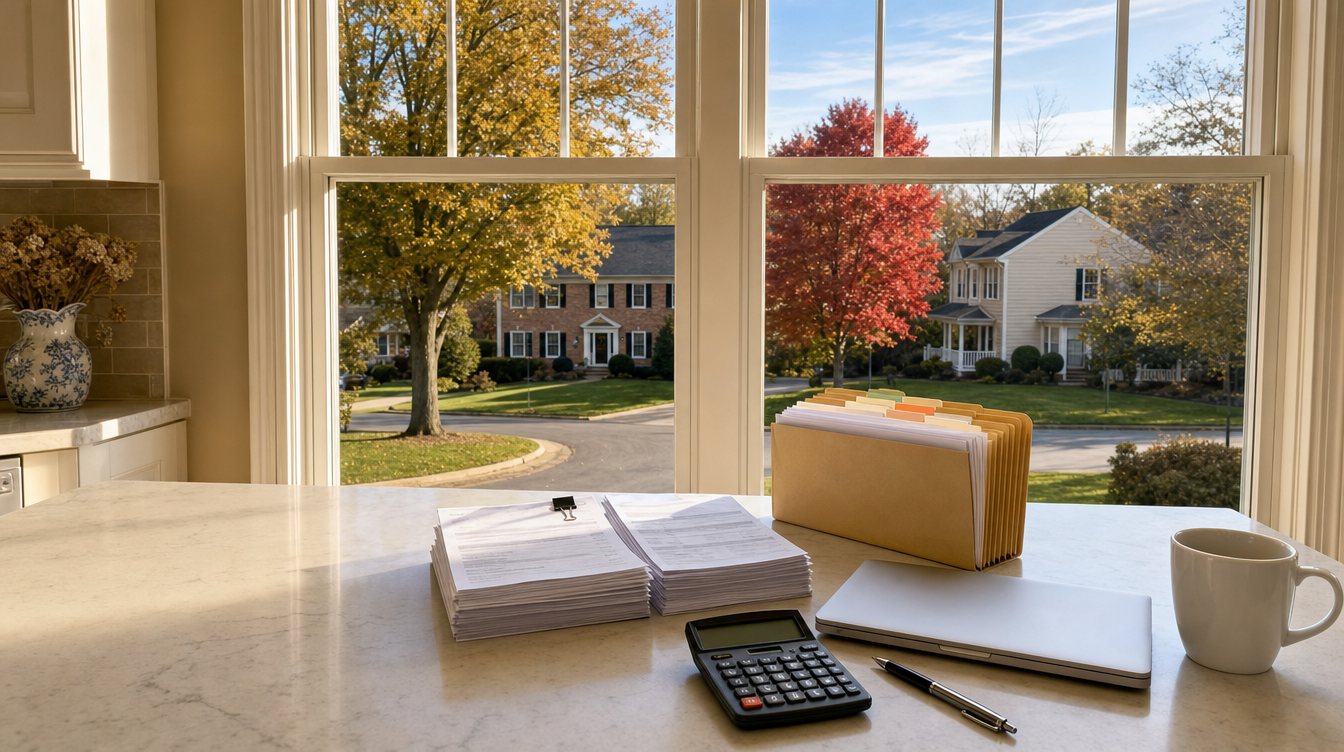
Organized loan paperwork on a kitchen island overlooking an autumn street in Franklin Farm, a concept image
Franklin Farm A loan file the underwriter can approve: full statements, pay stubs, one folder. AI concept image.

The freeze list

From application to keys: what to stop, and what to keep doing.

Your loan was approved on a snapshot of your credit, job and bank accounts. Anything that changes that snapshot has to be checked again, and that is where most delays start.3

Don’t

  • Open new credit. No new cards, car loans or “0% for 12 months” furniture. A new inquiry means the lender must confirm you took no new debt, and new debt can change your approval.2,3
  • Change jobs or pay type. Quitting, switching employers, moving from salary to commission or going self-employed all have to be re-checked.4
  • Deposit cash or unexplained money. Money the lender can’t verify can’t be used for your down payment, closing costs or reserves.5
  • Move money between accounts. Every transfer needs statements from both accounts. Leave it where it is.7
  • Co-sign for anyone. Their loan becomes your debt on paper.
  • Close cards or dispute credit items. Paid-off cards can stay open.20 A dispute can make the system re-run your file.21

Do

  • Answer the same day. Send what the lender asks for, complete, the day they ask.
  • Send whole statements. All pages of the most recent two full months, even the blank pages.7
  • Keep paying every bill on time. Autopay everything until closing.
  • Set up gift money early. Gift letter plus a record of the transfer.8
  • Call before you change anything. A job offer, a big purchase or a new account: ask your loan officer first.
  • Call before you wire. Use a phone number you already trust, never one from an email.16

Watch the file

What one change does to a loan file that was ready.

Pick a change and watch the underwriter’s desk. Every change sends the file back for another check, and that second check is the delay.3,4,5

Pick a change above to see what the underwriter has to do.

The car-loan test

Will a new car payment tip your approval? Try it.

Your debt-to-income ratio is every monthly debt payment, including the new house payment, divided by your monthly income before taxes. Fannie Mae’s ceiling is 45% for a manually underwritten loan and 50% for an automated (DU) approval.23

Fannie Mae’s limits shown. FHA, VA and other loans use their own rules, and your lender can be stricter. Ask your loan officer for your number before you sign for anything.

Try it yourself

Will a deposit need a paper trail? Check it here.

For a purchase loan, Fannie Mae and Freddie Mac call a single deposit “large” when it is more than 50% of your total monthly qualifying income. Large deposits need proof of where the money came from.5,6

  1. The bank statement that shows the deposit
  2. Where it came from: the other account’s statement, a bonus pay stub, a sale receipt or a gift letter
  3. A short signed note explaining it, if your lender asks

This checks the written Fannie Mae and Freddie Mac rule for purchase loans only.5,6 FHA loans have their own rules; for example, earnest money over 1% of the price needs its source documented.9 Lenders can also ask about smaller deposits.

Gift money

Family helping with the down payment? Four pieces of paper make it count.

  1. Gift letterSigned by the giver: the amount, that it never has to be repaid, and their name, address, phone and how they’re related to you.9,10
  2. Their statementProof the money was in the giver’s own account.8
  3. The transferThe wire or transfer record from their account to yours, or straight to the settlement agent.8
  4. Your statementIf it went to your account, the statement that shows it arriving.
Who can give you gift money, by loan type
LoanWho can giveWho can’t
Conventional (Fannie Mae)A relative by blood, marriage, adoption or legal guardianship, and other people the guide lists8The builder, the developer, a real estate agent or anyone else with an interest in the sale8
FHAFamily, your employer or union, a close friend with a documented interest, a charity, a government program9Anyone with an interest in the sale
VAA donor with no tie to the builder, developer, real estate agent or other interested party10Anyone with an interest in the sale10

Tip: move gift money early, ideally before you apply, and tell your loan officer it’s coming. A gift that shows up the week of closing is the classic last-minute scramble.

The 3-day clock

Three late changes restart the 3-day wait before closing.

The Closing Disclosure must reach you at least 3 business days before closing. If one of these changes after that, you get a new one, and the 3 days start over.11

  • The APR changes too much. The annual percentage rate is no longer accurate.
  • The loan product changes. For example, fixed to adjustable.
  • A prepayment penalty is added.

Try a late change:

Smaller changes don’t restart the clock, but they still need a corrected form. So the best move is the same: no changes to your loan in the last week.

Wire fraud

The one email that can take your down payment.

Scammers send an email that looks like it’s from your agent or settlement agent, with “new” wiring instructions.16 Real estate losses reported to the FBI rose 58% in one year.15

Real estate fraud reported to the FBI’s IC315

2024$173.6 million · 9,359 complaints
2025$275.1 million · 12,368 complaints

The FBI’s real estate category also counts rental and timeshare fraud, not only home closings.15

Spot the fake. This email is a made-up example.

From Closing Team <[email protected]>

Subject URGENT: updated wiring instructions, wire today

Hi, our bank changed after an audit. Please send your closing funds to the new account below so your closing isn’t delayed. We’re in meetings all day, so reply by email instead of calling.

New account: •••• •••• 4417

  1. A lookalike address. “tltle” with an L, not “title.” Read every letter.
  2. A rush. Pressure to wire today is how they stop you from checking.
  3. “New” account details by email. Treat any change to wiring instructions as fraud until you confirm it by phone.16
  4. “Don’t call.” The scammer can’t answer the real office phone. Call it.
Before any wire: call the settlement agent at a number you got at the start of the deal, or from their official website, and read the account number back to them. If any email changes the instructions, stop and call.16
A settlement table set for signing, with the historic Fairfax County Courthouse seen through the window, a concept image
City of Fairfax The settlement table, with the historic Fairfax County Courthouse across the street. AI concept image.

Virginia closings

Two Virginia rules every buyer should know.

You choose the settlement agent.

Virginia law gives the buyer the right to pick who handles the escrow and the closing. A seller can’t make you use a certain company as a condition of the sale.17

2 business days to record and pay out.

After settlement, the settlement agent must record the deed and the deed of trust and pay out the money within 2 business days.18

Behind the scenes

What slows loan officers and underwriters down.

No agency publishes a ranking of delay causes. This list comes from common lender practice and from what I see on my own deals.

  1. Missing pages. A statement with page 3 of 5 missing goes back to you, and the clock keeps running.
  2. Answers in pieces. One document today, another on Friday. Each one waits in line again.
  3. Surprise deposits and transfers. Each one needs a source and sometimes a signed letter.5
  4. Self-employed paperwork. Tax returns, business statements and year-to-date numbers take longest to collect. Start before you apply.
  5. Late gift money. The four pieces of paper above, gathered in closing week.
  6. Appraisal timing. Freddie Mac reports its loans that skipped the appraisal closed about 14 days faster on average for purchases, as of the second quarter of 2025.19
  7. Insurance, HOA and condo papers. Order homeowners insurance early, and ask how fast the HOA sends its documents.

Questions

What buyers ask about keeping a mortgage on track.

How do I keep my mortgage from getting delayed?

Freeze your money picture from application to closing: no new credit, no job changes, no moving money between accounts and no deposits you can’t prove. Send every document your lender asks for, complete, the same day. Most delays come from a change the underwriter has to check again.

Can I open a credit card before closing on a house?

Wait until after closing. The CFPB advises against applying for credit cards, car loans or other credit during the mortgage process, and Fannie Mae requires lenders to confirm that a recent credit inquiry did not lead to new debt. New debt has to be counted, which can change your approval.2,3

Can I change jobs while buying a house?

Talk to your loan officer before you accept. Fannie Mae has lenders confirm your job within 10 business days before closing, and a change in employment has to be fully re-evaluated. A new job can still work, but it needs paperwork such as a signed offer letter, and it can add time.4

What counts as a large deposit for a mortgage?

For a purchase loan, Fannie Mae and Freddie Mac treat a single deposit as large when it is more than 50% of your total monthly qualifying income. You’ll need to show where it came from, such as a statement from the other account, a bonus pay stub or a gift letter. Money that can’t be verified can’t be used for the down payment, closing costs or reserves.5,6

How do I use gift money for a down payment?

Get a gift letter signed by the giver with the amount, a statement that it never has to be repaid, and their name, address, phone and relationship to you. Then keep proof the money was in their account and a record of the transfer to you or to the settlement agent. Each loan type has its own list of who can give.8,9,10

Why did my closing get pushed back 3 days?

If the APR changes beyond the allowed amount, the loan product changes, or a prepayment penalty is added after you get your Closing Disclosure, the lender must give you a corrected one at least 3 business days before closing. That restarts the wait.11

How long does it take to close on a house in 2026?

The average purchase loan closed in 36.8 days in March 2026, according to ICE Mortgage Technology: about 11 days from application to rate lock and 26 days from lock to closing. Your own timeline depends on your contract, your loan and how fast documents come in.1

Who chooses the settlement company in Virginia?

The buyer does. Virginia law gives the purchaser or borrower the right to choose the settlement agent, and a seller can’t require a particular one as a condition of the sale.17


Working with me?

Get the full step-by-step checklist in the client area.

My clients get the complete version: what to gather before the offer, what to do in the first 72 hours under contract, the closing-week list, and ready-to-use letter outlines. Your code is in your invitation.

Open the client areaCall Ahmed 734.383.6945

Read: what 1% on the rate costs you each month →

Your question

Send me your question. It could be next week’s answer.

Ask about buying, selling, renting or a town. I answer in English or Arabic, and I never publish your name.

Keep reading